
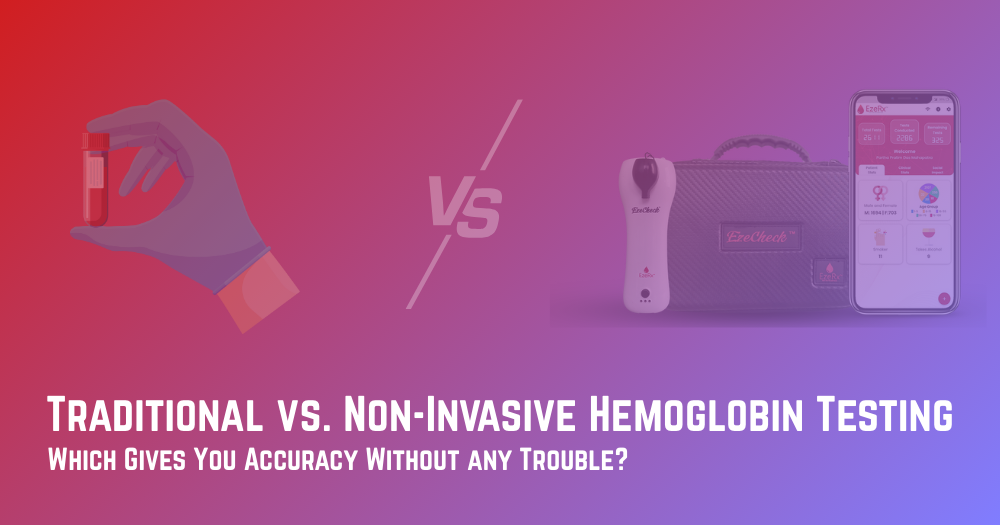
Why test hemoglobin levels? It’s a question that often comes up when the topic of blood health is raised. In India, where preventive healthcare is still gaining ground, most people test hemoglobin only when a doctor asks for it or when symptoms become hard to ignore.
Hemoglobin testing is one of the most essential diagnostic tools in modern healthcare. From identifying anemia to tracking long-term health, the accuracy of this test can make a real difference in patient outcomes. With innovations in medical technology, we are witnessing a major transformation in how hemoglobin levels are monitored. Today, non-invasive hemoglobin tests are emerging as powerful non-invasive hb monitoring alternatives to traditional blood-draw methods, providing faster, painless, and highly accessible solutions as a practical alternative to hb blood samples.
At the forefront of this change is EzeRx, whose EzeCheck device is revolutionizing the way we detect and manage hemoglobin levels. In this article, we explore the differences, accuracy, and use cases for both traditional and non-invasive methods while examining why EzeCheck has become the most trusted choice worldwide.
Hemoglobin is a vital protein found inside red blood cells that carries oxygen from the lungs to every tissue and organ. It also transports carbon dioxide back to the lungs for exhalation. Normal hemoglobin levels vary depending on age and gender, but for adults, they typically range between 13.8–17.2 g/dL in men and 12.1–15.1 g/dL in women.
Understanding these levels is crucial because low hemoglobin is the first sign of anemia, a condition affecting over 1.6 billion people worldwide. Regular hemoglobin tests are essential not only for anemia screening but also for detecting other hidden health issues, including iron deficiency, chronic illnesses, or even serious conditions like kidney disease.
In short, the importance of hemoglobin testing goes beyond a routine check it is a critical marker of overall health.
Traditional hemoglobin testing, though widely used, often requires invasive blood collection and delayed lab analysis. The most common procedure is the Complete Blood Count (CBC), which involves:
Benefits of Traditional Testing: Its Highly accurate and reliable,widely recognized as the gold standard and suitable for detailed diagnosis
Limitations: Invasive and painful for many patients Time-consuming when labs are involved Requires skilled technicians and sterile conditions
Common Hemoglobin Estimation Methods Compared
Between traditional venous draws and completely non-invasive methods lies the finger-prick hemoglobin test a minimally invasive alternative that deserves special attention. Often called a capillary blood test, this method uses a small lancet to prick the fingertip, collecting a drop of blood for immediate analysis on a portable hemoglobin meter. But how accurate is finger prick hemoglobin testing really? While more convenient than lab tests, its accuracy can be influenced by several factors: proper technique in collecting the blood drop, device calibration, and potential sample contamination. Clinical studies show finger-prick methods typically achieve 90-95% correlation with laboratory venous tests making them sufficiently reliable for routine screening and monitoring, though not quite the gold standard for definitive diagnosis. This balance of reasonable accuracy with minimal discomfort makes it a popular choice for at-home hemoglobin tests and rapid point-of-care assessment, bridging the gap between full laboratory precision and the convenience of non-invasive alternatives.
on-invasive hemoglobin tests are advanced diagnostic tools designed to measure hemoglobin levels without drawing blood. Instead of needles, they use light and sensors to provide quick and comfortable results like EzeCheck from EzeRx
The EzeCheck non-invasive hemoglobin meter by EzeRx is a game-changer in this field. Patients simply place their finger on the sensor, and within 60 seconds, the device delivers results directly to their phone via SMS or WhatsApp. This means no needles, no pain, and no blood draw. The portable device is ideal for healthcare providers (ICMR-RMRCBB validated with ~93% accuracy). This makes EzeCheck a trusted anemia screening device that combines speed, accuracy, and accessibility.
Traditional laboratory methods are considered the gold standard because they directly measure hemoglobin from a blood sample. These tests offer precise, reproducible results and are used in hospitals and clinics worldwide.
Non-invasive methods estimate hemoglobin levels using optical technology. While they may show slight variation compared to lab-based tests, EzeCheck has achieved 93% accuracy in ICMR-RMRCBB validation studies, making it highly dependable for anemia screening programs.
For field testing and large-scale health campaigns, non-invasive methods like EzeCheck are far more practical:
Thus, while traditional tests remain superior for clinical precision, non-invasive devices provide the best solution for rapid, mass screening.
When it comes to non-invasive anemia screening, EzeCheck by EzeRx has become the globally most trusted non-invasive hemoglobin screening device. Its advantages are clear:
With its technology and ease of use, EzeCheck is setting a new global standard in preventive healthcare.
The choice between traditional hemoglobin testing and non-invasive screening depends on the setting and purpose. While labs remain the gold standard for clinical precision, devices like EzeCheck are bridging the gap between accuracy, comfort, and accessibility.
By combining painless testing, instant results, and clinical validation, EzeCheck is transforming how we fight anemia across the world. Its role in national health programs proves that the future of hemoglobin screening is not just about precision it’s about reaching more people, more effectively.
Q1: How accurate are non-invasive hemoglobin tests like EzeCheck?
Answer- Non-invasive hemoglobin tests have revolutionized anemia screening with impressive accuracy. Devices like EzeCheck use optical spectroscopy to measure hemoglobin through the fingertip without drawing blood. In validation studies by ICMR-RMRCBB, EzeCheck achieved approximately 93% accuracy compared to laboratory gold standards. While traditional blood tests remain the benchmark for clinical diagnosis, non-invasive hemoglobin test accuracy is more than sufficient for mass screening, routine monitoring, and identifying at-risk populations quickly and comfortably.
Q2: Is a finger-prick hemoglobin test considered invasive? How accurate is it?
Answer- Yes, a finger prick hemoglobin test (also called a hemoglobin capillary test) is considered minimally invasive because it breaks the skin. A small lancet pricks the fingertip to draw a blood drop for analysis. Its accuracy is good but can be affected by technique, device calibration, and sample quality. While less accurate than venous lab tests, it's more precise than non-invasive methods and serves as a reliable middle ground for point-of-care testing in clinics and home hemoglobin tests.
Q3: How can I check my hemoglobin at home without a blood test?
Answer- The only way to check hemoglobin without blood is using a non-invasive hemoglobin meter like EzeCheck. These noninvasive hemoglobin monitoring devices use light sensors on the fingertip and provide results in under 60 seconds. For true hemoglobin test without blood, this technology is currently the most accessible alternative to HB blood samples, available through certain healthcare providers and screening programs.
Q4: What are the best at-home hemoglobin test methods?
Answer- The best hemoglobin test at home options include: 1) Non-invasive hemoglobin monitors (like EzeCheck) for painless, instant results; 2) At-home hemoglobin test kits that use finger-prick blood collection with mail-in lab analysis; and 3) Portable digital haemoglobin meters designed for home use. For pure convenience and comfort, non-invasive devices lead, while traditional finger prick methods offer slightly higher accuracy for home hemoglobin test needs.
Q5: Are home hemoglobin test kits accurate?
Answer-Home hemoglobin test accuracy varies by method. FDA-approved hemoglobin test at home kits using finger-prick samples with lab analysis can be very accurate. Non-invasive home hemoglobin tests (like smartphone-connected devices) typically have 90-95% accuracy suitable for screening but not diagnosis. The key is choosing validated devices and understanding that home hemoglobin tests are best for trend monitoring rather than definitive medical diagnosis.
Q6: What is a non-invasive hemoglobinometer or hemoglobin meter?
Answer- A non-invasive hemoglobinometer (also called a non-invasive hemoglobin meter or non invasive HB meter) is a medical device that measures hemoglobin levels without needles. Unlike traditional hemoglobin test machines that analyze blood samples, these hemoglobin monitors use optical sensors placed on the fingertip or earlobe. The EzeCheck device is an example of this non-invasive hemoglobin technology, making checking hemoglobin levels painless and instantaneous.
Q7: What are the different methods to measure hemoglobin levels?
Answer- The main hemoglobin estimation methods are: 1) Laboratory CBC (most accurate, uses venous blood), 2) Finger-prick hemoglobin test (capillary blood, good for quick checks), 3) Non-invasive hemoglobin monitoring (optical technology, best for screening), and 4) Portable hemoglobin analyzers (used in clinics).The instrument used varies from large lab hematology analyzers for CBC to portable digital haemoglobin meters for point-of-care testing. Understanding these hemoglobin methods helps choose the right test for your needs.
