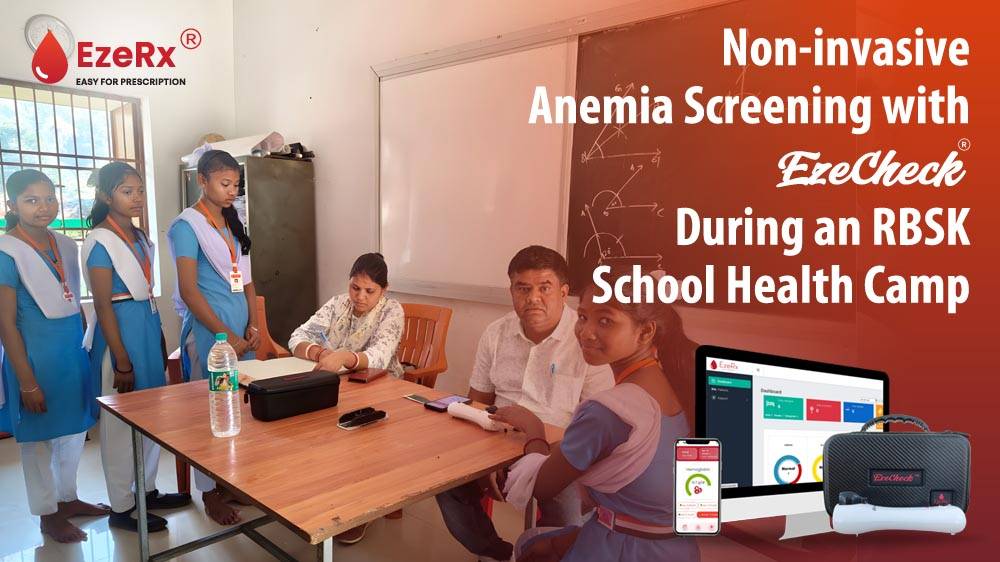
Imagine trying to convince a frightened child in a remote Odisha village that a needle prick is for their own good. This was the daily reality for the dedicated teams of Odisha’s Rashtriya Bal Swasthya Karyakram (RBSK).The challenge was immense:How can a lifesaving, non‑invasive hemoglobin test be scaled across India to enhance screening processes that are currently slow, intimidating, and logistically challenging?
A pivotal shift began in July 2025, when the Odisha state officially onboarded a new tool. By September, a quiet revolution was underway in screening camps across all 30 districts of Odisha. Mobile health teams deployed EzeCheck(EzeRx Device), a pioneering non-invasive hemoglobin screening device, turning a dreaded procedure into a quick, painless check-up. This isn't just a pilot; it's an ongoing program integrated into the state's public health framework. Let's look at the data: with over 3 lakh+ individuals screened already, the story of efficiency, trust, and scale is being written in real-time. This case study uncovers exactly how this painless anemia test is reshaping rural health screening in Odisha.
In the push to achieve India's National Anemia Mukt Bharat goals, the Odisha government faced a practical bottleneck. The RBSK's vision for comprehensive school health screening was being hampered by the very tools designed to help. The formal adoption of EzeCheck in mid-2025 and its field deployment from September wasn't just an upgrade; It was a necessary evolution to make the widespread detection of anemia in children in India a practical, scalable reality.
The Rashtriya Bal Swasthya Karyakram (RBSK) is a visionary national program aimed at the early identification and management of health issues in children from birth to 18 years. A core component is screening for anemia, a condition that silently impairs cognitive development and physical growth, affecting long-term potential.
However, the traditional blood-based testing method created significant roadblocks for rural health screening in Odisha:
Within India’s RBSK child health programme, shifting from invasive needle‑based tests to non‑invasive screening methods was not just creative, it was essential to the programme’s success.
The device powering this transformation is EzeCheck - a non-invasive hemoglobin screening device. This Indian-made tool uses advanced optical spectroscopy to measure hemoglobin levels through a simple, painless fingertip scan, delivering a result in about 60 seconds - zero needles, zero blood, and zero consumables.
Let's talk about trust. EzeCheck isn't just convenient; it's clinically validated. Its accuracy is backed by:
Here’s how it works: The child simply places their finger over the device’s finger bed area. EzeCheck then uses a safe, painless method called Absorption spectroscopy to measure hemoglobin levels through the skin.The result appears on the screen in about 60 seconds zero needles, zero blood, and zero consumables.
The deployment was built on a foundation of rigorous training and trust:
The company behind EzeCheck is EzeRx Health Tech, an Indian MedTech innovator focused on making preventive healthcare accessible. EzeRx didn't just supply devices; it ensured the program's success through end-to-end support. A dedicated field force of over 20 employees was deployed for the maintenance and calibration of all 640 devices in the field, providing crucial on-ground assurance to the health teams.
The rollout was methodical and large-scale. EzeRx integrated its support system directly with the government's mobile health teams and deployed a dedicated field force of over 20 personnel to ensure operational smoothness.To ensure sustainable implementation, EzeRx takes full responsibility for the maintenance and calibration of all field-deployed devices.
The scale of this ongoing project is state-wide and systematic.
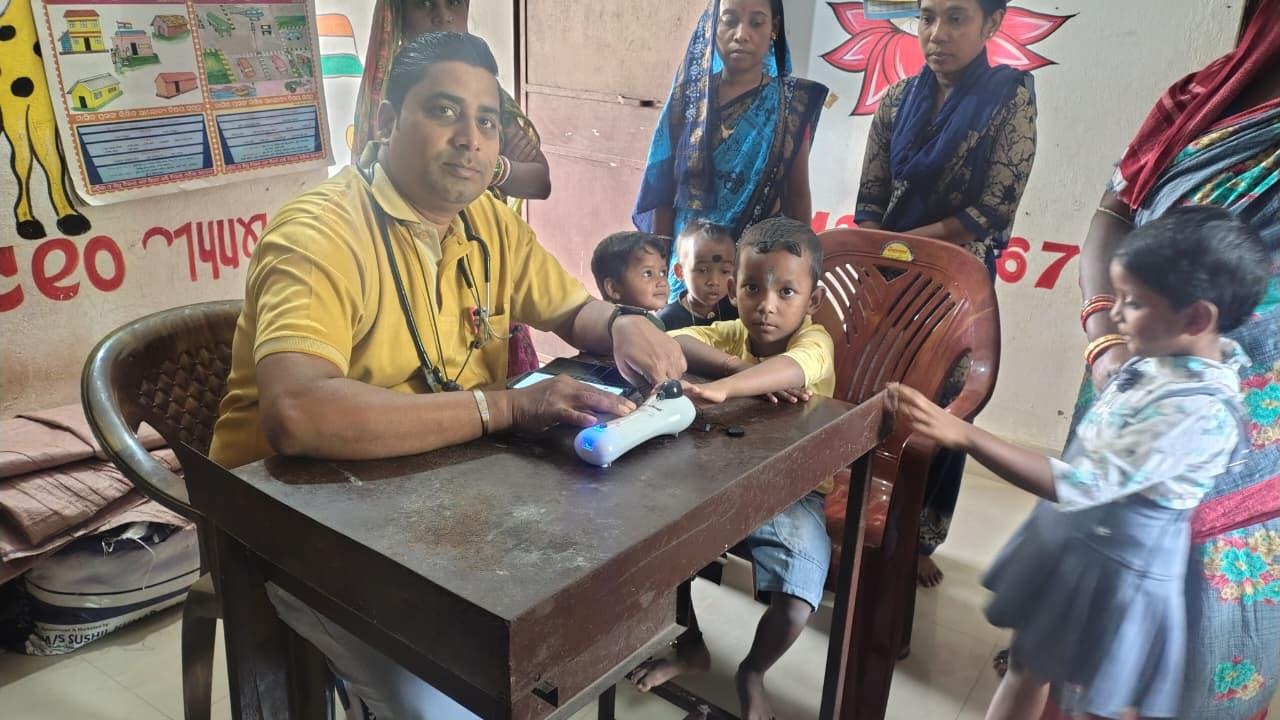
The numbers from the field paint a clear picture of transformed efficiency. The following table compares the key outcomes:
|
Metric |
Before EzeCheck (Estimated) |
With EzeCheck (Actual Data) |
Improvement & Impact |
|
Screening Speed |
~5-10 min per child (with prep) |
~60 seconds per test |
Time per test reduced by ~80-90% |
|
Team Throughput |
Limited by blood-draw logistics |
80-100 screenings per device, per day |
A single team can screen a whole school rapidly |
|
Total Screened |
N/A (Previous method slower) |
Over 2.8 Lakh Individuals (and counting) |
Unprecedented scale achieved |
|
Anemia Detection |
Data delayed |
93 % Accuracy by using EzeCheck |
Enables immediate triage & action |
Beyond the numbers, the human impact is profound, best told by the frontline heroes.
“My name is Dr. Prachi Gupta, from MHT-1 Baunsuni, District Boudh... The best part is that it requires no needle pricks, so the children are no longer afraid of testing.” - Dr. Prachi Gupta, Odisha RBSK Team.
“During the testing, our students are very happy... We are saving time, money, and even blood.” – Dr. Mandakini Dash, Ganjam District
“I am using EzeRx's EzeCheck since 2 years, test results are very good. Even we have compared it with the blood test for the same person, results are very similar.” Dr. Sushree Sagarika Rout, CHO, Nayahata Swasthya Arogya Kendra
“Initially, we were taking blood from children by pricking for which they were suffering from pain, but now it's not painful anymore... but if the 1 minute process time could be reduced to 20-30 seconds, it would be more helpful.” - Dr. Soumya Ranjan Aacharya, Katpad MHT-2 RBSK Team
Let's be clear this isn't about replacing lab tests for clinical diagnosis. It's about choosing the right tool for the job of mass screening. In the context of public health deployment across in India, the difference is stark.
Odisha’s state-wide rollout provides a scalable blueprint. Key lessons include the critical importance of investing in structured training (the 15-day program) and dedicated field support (20+ EzeRx personnel) for sustainable adoption. This model is perfectly suited for CSR and NGO partnerships to expand such inclusive health initiatives.
With 640 devices already active in Odisha, the infrastructure for a long-term health monitoring network is in place. The future lies in leveraging this IoT-enabled data for real-time public health dashboards and extending this proven model to other vulnerable groups nationwide.
The Odisha RBSK case study demonstrates a clear truth: when you remove pain and complexity, you unlock scale and trust. By screening over 2.8 lakh people across all districts and school types, EzeCheck has proven itself as a catalyst for a more efficient, compassionate, and data-driven public health system. This ongoing program stands as a powerful call to action for health departments nationwide to embrace solutions that are as humane as they are effective.
Answer: The Odisha RBSK program uses EzeCheck a non-invasive hemoglobin monitoring device. It provides a painless, needle-free test with results in 60 seconds, approved for public health screening. This makes it ideal for rapid, large-scale testing of children in school camps.
Answer: Yes. EzeCheck is an ICMR-RMRC validated device and is CDSCO approved. It was formally onboarded by the Odisha government in July 2025 for state-wide RBSK screening, confirming its acceptance and trust for national health missions like Anemia Mukt Bharat.
Answer: Non-invasive tests like EzeCheck eliminate needle fear, drastically increasing child participation. They are faster (~1 minute/test), require no consumables, and allow a single team to screen over 80 children per day, making school health camps far more efficient and scalable.
Answer: EzeCheck shows high correlation with standard lab tests, with ICMR- RMRC validated accuracy. Peer-reviewed studies (e.g., PLOS Digital Health) confirm it performs well across age groups with high sensitivity and specificity, making it reliable for mass screening and triage.
Answer: Absolutely. EzeCheck is designed for rural and remote screening. It functions offline, is portable, and data can be syncled later. In Odisha, over 640 devices are deployed across all 30 districts, proving its effectiveness in low-connectivity settings.
