
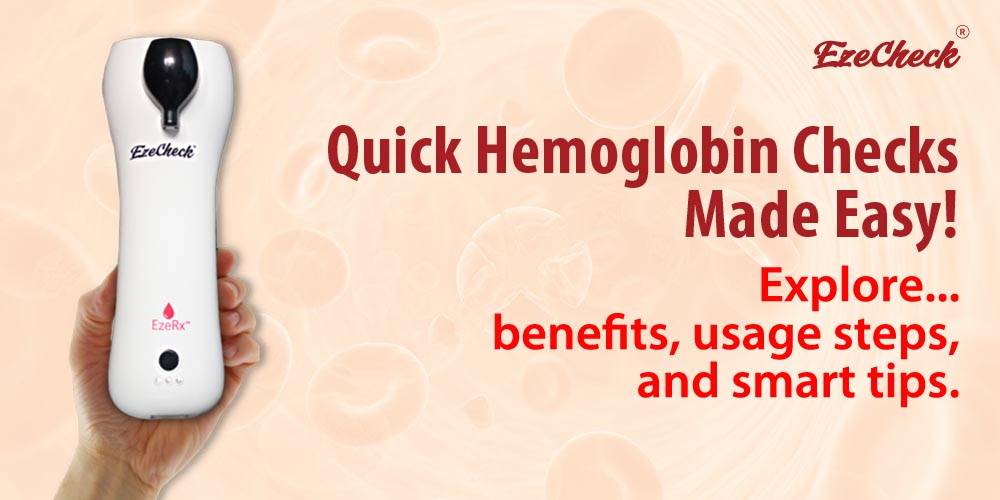
In a country where the National Family Health Survey-5 (NFHS-5) reports that over 57% of women and 31% of men in the reproductive age group are anemic, the need for rapid, reliable, and accessible hemoglobin screening has never been more critical. Enter the digital hemoglobinometer, a modern point-of-care device designed to deliver immediate results outside the confines of a traditional lab. This article provides a comprehensive look at what this device is, how it works, and delves into the specifics of EzeCheck by EzeRx a portable digital hemoglobinometer that is transforming anemia screening with ICMR- RMRCBB validated accuracy of over 93% and a remarkably low cost of just Rs. 10 per test.
What is a Digital Hemoglobinometer? Understanding the Basics
At its core, a digital hemoglobinometer is a portable, often handheld, medical device that measures the concentration of hemoglobin in your blood. Hemoglobin is the iron-rich protein in red blood cells responsible for carrying oxygen throughout your body. Traditionally, measuring it required a venous blood draw and analysis in a laboratory, a process that could take hours or even days. A portable digital hemoglobinometer like EzeCheck changes this paradigm by providing a result at the point-of-care, often in under a minute, making it indispensable for large-scale screenings, rural health camps, and busy clinical settings.
What Makes a Digital Hemoglobinometer Different?
The key differentiators of a modern digital device over older methods are its portability, speed, and user-centric design. Unlike bulky lab analyzers, devices like EzeCheck are lightweight and battery-operated, enabling testing anywhere. They eliminate the need for chemical reagents and extensive sample preparation. The process is significantly faster, providing results in seconds, which is crucial for timely decision-making. While some advanced models are fully non-invasive, others, including EzeCheck, utilize a minimally invasive fingerstick method that is far less intimidating than a venous draw. This blend of portability, speed, and convenience makes EzeCheck a superior alternative for efficient public health management.
The Science Behind the Test: How Hemoglobin Measurement Works
Understanding the principle of the hemoglobin test demystifies the process. Most point-of-care digital hemoglobinometer devices operate on the principle of photometry. A specific wavelength of light is passed through a small blood sample. Hemoglobin absorbs this light in a predictable way; the more hemoglobin present, the more light is absorbed. The device's photodetector measures the light that passes through and an internal algorithm calculates the hemoglobin concentration based on this absorption. The EzeCheck device employs this proven scientific principle with refined optics and AI-driven algorithms to ensure its high accuracy, validated by the Indian Council of Medical Research (ICMR- RMRC).
Common Uses and Importance of Hemoglobin Testing
What is the Main Use of Hemoglobin in the Body?
The main use of hemoglobin is to act as the primary oxygen carrier in the bloodstream. It binds to oxygen in the lungs and transports it to every tissue and organ in the body, ensuring they function properly. It also helps carry a portion of carbon dioxide back to the lungs for exhalation. Without adequate hemoglobin, the body's tissues become starved of oxygen, leading to fatigue, weakness, and the clinical condition known as anemia.
What is the Use of a Hemoglobinometer?
The use of a hemoglobinometer is vast and critical in preventive and diagnostic medicine. Its primary applications include:
Can a Digital Hemoglobinometer Detect Anemia?
Yes, absolutely. A digital hemoglobinometer can detect anemia with high reliability. Anemia is defined by a low hemoglobin concentration. By providing a precise numerical value of hemoglobin levels, these devices allow healthcare workers to immediately identify anemic individuals based on established WHO and ICMR thresholds. The EzeCheck device, with its high correlation to standard analyzers, is a vital tool for the early detection and monitoring of anemia, enabling timely intervention.
Introducing EzeCheck: The Advanced Digital Hemoglobinometer from EzeRx
EzeCheck, developed by EzeRx, represents a significant leap forward in hemoglobin testing technology. It’s not just a device; it's a comprehensive solution designed for the real world. Key features that set the EzeCheck HB machine apart include:
ICMR- RMRC Validated Accuracy: Demonstrating over 93% concordance with standard reference methods.
A Step-by-Step Guide: How to Use Your EzeCheck Device
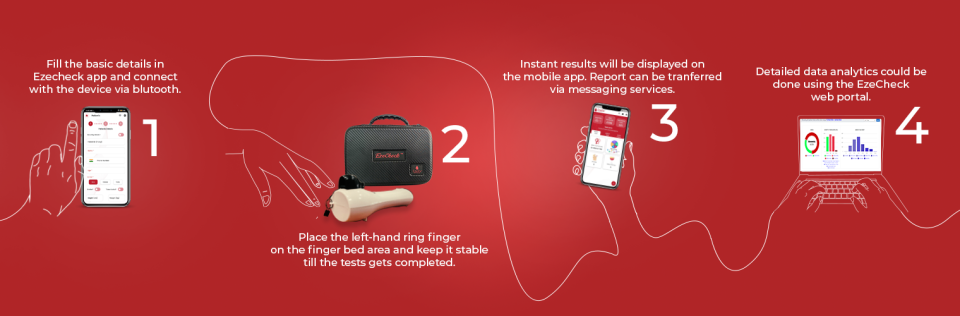
Using the EzeCheck hemoglobinometer is a straightforward process designed for minimal training. Here is a simple, numbered guide:
Preparation: Ensure the device is charged and the fingertip biosensor is clean.
Patient Setup: Gently place the patient's finger on the designated sensor port.
Initiation: Press the start button. The device will emit a cool white LED light to perform the photometric analysis.
Reading the Result: In about 60 seconds, the hemoglobin value will be displayed clearly on the screen.
Data Logging: The result can be stored in the device's memory and shared instantly via integrated connectivity options.
Accuracy and Reliability of Digital Hemoglobinometers
The accuracy of a digital hemoglobinometer is paramount. Independent peer-reviewed studies substantiate the performance of devices like EzeCheck. A study published in PLOS Digital Health confirmed that EzeCheck could detect anemia with high sensitivity and specificity. Another community-based study found a strong agreement with standard analyzers, with over 93% of EzeCheck results falling within a clinically acceptable +/- 1.5 g/dL difference.
Is Fingerstick Hemoglobin Accurate? The New Alternative: EzeCheck
The question of "Is fingerstick hemoglobin accurate?" is a common one. While traditional fingerstick methods can be prone to user error in sample handling, a integrated digital hemoglobinometer like EzeCheck minimizes this by automating the entire analysis process within the device. This eliminates variables like manual dilution or timing, making the EzeCheck method a highly accurate and reliable alternative to older, more error-prone point-of-care methods.
Can a Hemoglobin Test Be Wrong? Understanding Margin of Error
Can a hemoglobin test be wrong? Any diagnostic test has a potential margin of error. Factors like improper calibration, extreme environmental conditions, or very poor peripheral circulation can affect results. However, modern devices are engineered to minimize this. The margin of error for a hemoglobin test with a well-validated device like EzeCheck is very low. The aforementioned studies indicate a mean difference as low as 0.5 gm/dl compared to laboratory gold standards, which is well within clinically acceptable limits for screening purposes.
Choosing the Right Device: Invasive vs. Non-Invasive Hemoglobin Tests
Which Test is Best for Hemoglobin: Invasive or Non-Invasive?
The debate on which test is best for hemoglobin, invasive or noninvasive, hinges on the trade-off between convenience and accuracy. Fully non-invasive devices offer maximum patient comfort but have faced challenges in achieving consistent accuracy across diverse populations and skin tones. Invasive methods, which use a tiny blood sample, have historically provided higher accuracy. EzeCheck strikes an optimal balance; it uses a minimally invasive fingerstick that is virtually painless, yet it delivers the high, ICMR-RMRC validated accuracy that healthcare programs require, making it a preferable choice for reliable mass screening.
How Can I Get an EzeCheck Device?
For institutions, public health programs, and healthcare providers looking to enhance their screening capabilities, acquiring an EzeCheck device is the next step. To get the most accurate and current information regarding the price of the EzeCheck HB machine and available procurement models, we recommend contacting EzeRx - www.ezerx.in/contact or directly through their official website. Their team can provide detailed pricing, bulk order cost, and demonstrate how the device can be integrated into your specific healthcare initiatives.
Why EzeCheck is the Smart Choice as a Digital Hemoglobinometer
In summary, EzeCheck stands out as a smart choice in the realm of digital hemoglobinometer technology because it is engineered not just for accuracy, but for impact at scale. It combines proven scientific principles with robust, field-ready engineering to deliver a rare combination of high accuracy, operational efficiency, and exceptional cost-effectiveness.
This makes it the ideal, scalable solution for flagship public health initiatives. EzeCheck is specifically designed to empower programs like Anemia Mukt Bharat, the RBSK program for school-going children, Beti Bachao Beti Padhao, and POSHAN Abhiyan, providing the reliable data needed to track their success. Furthermore, through collaborations with various CSR partners and NGOs, the technology is extending its reach, enabling hospitals, blood banks, OPDs, and occupational health centers to run efficient mass screening campaigns.
The tangible results speak for themselves. Our recent deployment with the Odisha RBSK team under the Swasth Nari, Sashakt Parivar Abhiyan facilitated over 2.5 lakh (250,000) anemia screenings. This initiative, where beneficiaries primarily school-going children who were once apprehensive now line up confidently for testing, is a powerful testament to its field efficacy and user acceptance. Backed by ICMR validation, independent scientific studies, and this proven on-ground performance, EzeCheck from EzeRx represents a reliable, scalable, and scientifically sound solution for any organization serious about tackling anemia and improving healthcare access.
Frequently Asked Questions (FAQ) About Digital Hemoglobinometers
Q: What is the price of the EzeCheck HB machine?
A: While the exact initial investment can vary based on the procurement model and quantity, the operational cost of using the EzeCheck device is strategically designed to be as low as Rs. 10 per test. For specific device pricing, please contact EzeRx directly for a customized quote.
Q: How accurate are hemoglobin meters?
A: The accuracy of high-quality hemoglobin meters is very high. The EzeCheck device, for instance, has been independently validated by the ICMR – RMRC to have over 93% accuracy and has shown strong correlation with standard laboratory analyzers in peer-reviewed studies.
Q: Can a hemoglobin test be wrong?
A: While no test is infallible, the likelihood of error with a calibrated digital device like EzeCheck is low. Its design minimizes common errors associated with manual methods, and its performance is consistently within a narrow, clinically acceptable margin of error.
Q: What is the margin of error for a hemoglobin test?
A: For a well-validated point-of-care device, a margin of error within +/- 0.5 to 1.0 g/dL of a laboratory standard is considered excellent. Research on EzeCheck has demonstrated performance well within this range, with a mean difference of 0.5 gm/dl in one study and over 91% of results within +/- 1.5 g/dL in another.
