
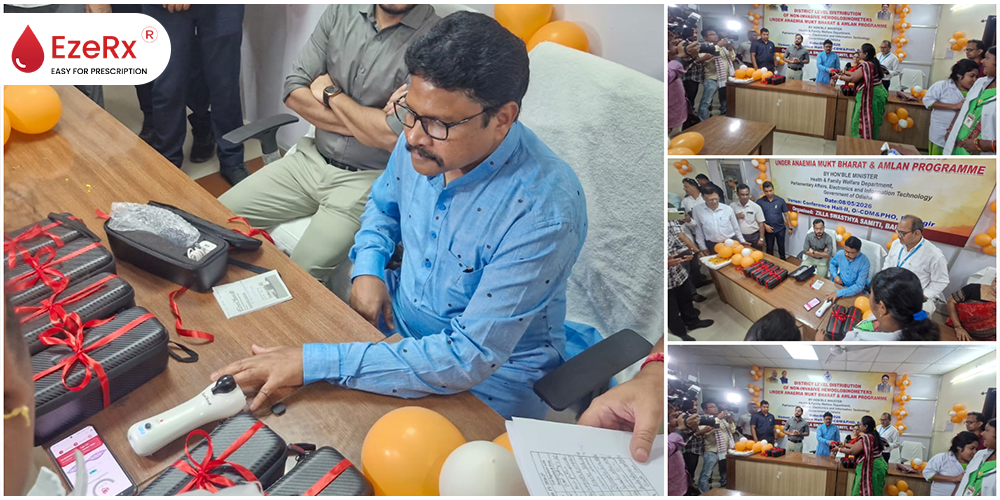
EzeRx, a MedTech innovator focused on non-invasive healthcare solutions, recently deployed its AI-powered EzeCheck hemoglobin screening device during a government-led health initiative in Balangir, Odisha. The deployment took place under the Anemia Mukt Bharat and AMLAN programs, implemented by the National Health Mission (NHM), Odisha, Health and Family Welfare Department.
During the event at the District Hospital, Hon’ble Health Minister of Odisha, Dr. Mukesh Mahaling, personally underwent a hemoglobin test using the EzeCheck device. The screening was completed without any blood sample collection, highlighting how AI-enabled diagnostic tools are gradually reshaping preventive healthcare delivery in India.
The EzeCheck device demonstrated its ability to deliver hemoglobin results in less than one minute, without the need for needles or blood withdrawal. This makes it particularly suitable for large-scale screening programs across both rural and urban healthcare systems, where speed and accessibility are critical.
As part of the initiative, 242 EzeCheck devices were deployed to support anemia screening efforts under the program. To ensure smooth implementation and effective field-level usage, the EzeRx team will also provide hands-on training to 250 Community Health Officers (CHOs) involved in the healthcare initiative.
Operating in an AI-driven screening mode, the device also generates instant digital PDF reports, allowing health workers to quickly record and share results. Designed for high-volume public health use, EzeCheck supports ongoing anemia detection efforts in schools, community health centers, and outreach camps, helping improve early identification and intervention.
Explaining the technology behind the device, Ankita Sahoo the CHO shared that EzeCheck works on an AI-based, non-invasive screening mechanism that removes the need for traditional blood sample collection. She noted that earlier hemoglobin testing methods required either venous or finger-prick blood samples, which often created hesitation among patients, especially in field settings.
With EzeCheck, the screening process is now simplified users can obtain results within approximately one minute, along with a downloadable PDF report. This makes the device particularly useful for frontline health workers conducting mass screening in remote and resource-limited environments.
She further added that the system operates in a screening mode with around 1% variation compared to standard CBC laboratory tests, making it reliable for preliminary anemia detection. In cases where clinical confirmation is required, a standard CBC test can still be performed, ensuring proper diagnostic validation and medical accuracy.
