
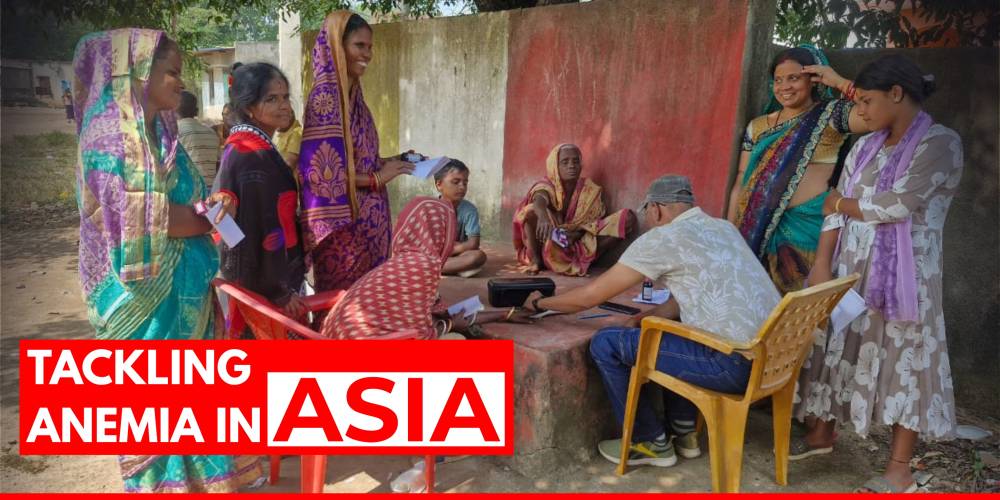
Anemia isn't just a medical term, it’s a quiet crisis affecting classrooms, workplaces, and homes across Asia. Picture this: a bright-eyed girl in rural India struggles to concentrate in school, not because she lacks curiosity, but because her body lacks enough healthy red blood cells to carry oxygen to her brain. Or a pregnant woman in Bangladesh feeling bone-tired not just from growing a human, but from severe iron deficiency. This is the human face of anemia, a condition that impacts over half a billion people across Asia, shaping lives, economies, and futures.
But here’s the hopeful part, Asia is fighting back. From national food fortification programs to AI-powered screening tools, countries across the continent are deploying innovative strategies to turn the tide. In this article, we’ll explore not just the sobering statistics but the science-backed solutions, unpacking medical frameworks like the 6-6-6 rule and the Rule of 3, while examining what’s working on the ground. Drawing on the latest data from the World Health Organization (WHO), the Global Burden of Disease Study, and national health surveys, we’ll map out the path forward because reducing anemia isn't just a health goal, it's a cornerstone for building stronger, more resilient communities.
To understand why anemia remains stubbornly prevalent across Asia, we need to look beyond simple explanations. While iron deficiency is the headline culprit, the full story weaves together dietary habits, economic realities, and even cultural practices.
Take iron deficiency first. It’s responsible for roughly 50–60% of anemia cases in Asia, but the reasons vary dramatically by region. In South Asia, particularly in India and Bangladesh, diets heavily reliant on rice and wheat staples that are often low in bioavailable iron create a nutritional gap. Even when vegetables are consumed, compounds like phytates in legumes and grains can inhibit iron absorption. Contrast this with parts of Southeast Asia like Indonesia and the Philippines, where fish consumption is higher, yet anemia persists due to parasitic infections like hookworm, which cause chronic blood loss.
Then come the socioeconomic layers. In low-income households across Pakistan and Nepal, anemia is often a symptom of broader systemic challenges: limited access to diverse foods, inadequate sanitation leading to recurrent infections, and healthcare systems that struggle to reach remote communities. Women and girls frequently bear the heaviest burden due to gendered norms around food distribution eating last and least compounded by iron losses from menstruation and the high demands of pregnancy. But perhaps the most overlooked factor is awareness. In many communities, the symptoms of anemia fatigue, paleness, shortness of breath are normalized as “just part of life” or attributed to hard work rather than a treatable condition. This normalization delays diagnosis and intervention, allowing anemia to silently undermine child development, maternal health, and adult productivity.
Let’s move from the “why” to the “how widespread.” The latest data paints a picture of uneven progress, with bright spots of improvement shadowed by persistent hotspots. According to the WHO’s 2024 Global Anaemia Estimates and the 2025 Global Burden of Disease (GBD) analysis, Asia remains home to the world’s largest number of people living with anemia, though prevalence varies sharply between subregions.
South Asia continues to face the highest burden. In India, the National Family Health Survey-6 (2023–24) indicates that approximately 52% of women aged 15–49 and 58% of children under five are anemic. Bangladesh and Pakistan report similarly concerning figures, with anemia affecting around 40–45% of women of reproductive age. These numbers reflect complex interactions between nutrition, sanitation, and healthcare access.
Southeast Asia shows a more mixed landscape. Countries like Thailand and Vietnam have made significant strides, reducing anemia prevalence to around 20–25% through integrated nutrition programs and economic development. However, in Indonesia and the Philippines, rates remain elevated at 30–35%, particularly in rural and impoverished urban communities.
East Asia, including China and Japan, reports the lowest prevalence generally under 20% thanks to stronger public health infrastructure, dietary diversity, and widespread food fortification policies. Yet even here, disparities exist. In western China, for instance, anemia rates are notably higher than in coastal cities, highlighting the role of regional inequality. To make sense of these variations, the table below breaks down anemia prevalence by country and vulnerable group, based on the most recent national surveys and WHO estimates:
Sources: WHO Global Anaemia Estimates 2024; National Family Health Surveys (India, Bangladesh); Demographic Health Surveys (Pakistan, Indonesia, Philippines, Nepal, Vietnam); Malaysian National Health and Morbidity Survey (NHMS) 2023; Chinese National Health Commission Report 2024.
When doctors and public health workers across Asia diagnose and categorize anemia, they often rely on two practical clinical tools: the 6-6-6 Rule and the Rule of 3. These aren't just mnemonics they're lifelines for quick decision-making in resource-limited settings.
Imagine a health worker in a rural Bangladeshi clinic seeing a listless three-year-old. They check the hemoglobin (Hb) level: it’s 6 grams per deciliter (g/dL). This triggers the “6-6-6 Rule”: a hemoglobin level of 6 g/dL or less in a child under 6 years old signals severe anemia requiring immediate intervention.
Why is this threshold so critical? At 6 g/dL, a child’s oxygen-carrying capacity is dangerously low, increasing risks of cardiac strain, developmental delays, and even mortality. The rule serves as a clear action point often prompting referral for packed cell transfusion or intensive iron therapy. In countries like India and Nepal, this rule is integrated into community health worker protocols, helping prioritize the most vulnerable children amidst overwhelming caseloads.
Meanwhile, in a hospital lab in Manila, a technician runs a complete blood count (CBC) for a pregnant woman. The results show:
Hemoglobin: 9 g/dL
Hematocrit: 27%
RBC count: 3 million/µL
She applies the Rule of 3, a classic hematology consistency check:
Hemoglobin (g/dL) × 3 ≈ Hematocrit (%) - 9 × 3 = 27
RBC count (million/µL) × 3 ≈ Hemoglobin (g/dL) - 3 × 3 = 9
When these relationships hold, it suggests the anemia is likely nutritional (like iron deficiency). If they deviate for example, if hemoglobin is disproportionately low relative to RBC count it raises flags for other conditions common in Asia, such as thalassemia or hemoglobinopathies. This rule helps clinicians avoid misdiagnosis and tailor further testing, especially in regions where genetic blood disorders overlap with nutritional anemia.
Tackling anemia at a population level requires more than clinical tools it demands systemic change. Across Asia, governments and NGOs are rolling out layered interventions that address both immediate deficiencies and underlying causes. In India, the Anaemia Mukt Bharat (Anaemia-Free India) initiative has become a cornerstone of the national nutrition strategy. It targets children, adolescents, women, and pregnant women through six key interventions: iron-folic acid supplementation, deworming, nutritional counseling, testing, and treatment. What’s innovative is its digital dashboards for real-time monitoring and its focus on frontline workers ASHA and Anganwadi workers who distribute “IFA Pink” tablets and conduct point-of-care testing in villages.
Meanwhile, the Philippines has taken a food fortification approach, mandating the addition of iron and other micronutrients to staple foods like rice, wheat flour, and cooking oil. This “silent” intervention reaches populations without requiring behavior change. Studies in fortification pilot areas have shown a 10–15% reduction in anemia prevalence within two years, a model now being adopted in parts of Indonesia and Vietnam.
But perhaps the most heartening progress is happening at the community level. In Bangladesh, women’s self-help groups in regions like Rangpur and Khulna are growing iron-rich vegetables in home gardens and promoting dietary diversification through peer-led cooking demonstrations. These groups also address social barriers, such as convincing husbands and mothers-in-law to support women’s nutrition. Similarly, in Nepal, female community health volunteers trek to remote hill villages with hemoglobinometers and iron supplements, bridging the last-mile gap in healthcare delivery
Looking ahead, the fight against anemia in Asia is entering a new phase one powered by technology, targeted policy, and cross-border collaboration.
Digital health tools are revolutionizing screening and monitoring. In Indonesia, mobile hemoglobinometers linked to smartphones allow community workers in Papua and West Kalimantan to test hemoglobin levels in seconds and upload data to central dashboards, triggering automated referrals for severe cases. Similarly, devices like EzeCheck—a non-invasive, bloodless hemoglobin test kitare enabling rapid screening in over 13 countries across the region, providing a reliable result in under 60 seconds and aiding in easier, large-scale detection. Validated by institutions like the ICMR-RMRC, such tools are critical for scaling up screening programs. In India, the EzeCheck app enables ANMS nurse midwives to track pregnant women’s hemoglobin level and anemia trends in real time, improving accountability.
Policy-wise, countries are shifting from standalone anemia programs to integrated nutrition-security frameworks. Vietnam’s National Nutrition Strategy, for example, links anemia reduction to climate-resilient agriculture, social safety nets, and water-sanitation-hygiene (WASH) programs. This recognizes that anemia isn’t just a health issue it’s also about food systems, environment, and equity.
Finally, regional partnerships are amplifying impact. The ASEAN and SAARC nutrition working groups are facilitating knowledge exchange, such as Thailand sharing its school-based iron supplementation model with Laos and Cambodia, or Sri Lanka advising Bangladesh on fortification quality control. These collaborations, supported by WHO and UNICEF, are helping countries avoid reinventing the wheel and accelerate progress toward the WHO Global Nutrition Target of halving anemia in women of reproductive age by 2030.
Frequently Asked Questions About Anemia in Asia
Q.Which Asian country has the highest anemia rate?
Based on recent data, India has one of the highest burdens, with over 50% of women and children affected. However, in specific subregions like the Terai plains of Nepal or rural Balochistan in Pakistan, localized rates can exceed 60%.
Q.Is anemia in Asia solely due to iron deficiency?
No. While iron deficiency is the leading cause, other factors include vitamin B12/folate deficiencies (common in vegetarian populations), parasitic infections (like hookworm in tropical regions), genetic conditions (thalassemia in Southeast Asia), and chronic inflammation.
Q.Can technology really help reduce anemia in remote areas?
Absolutely. Innovative medical devices are making screening faster, cheaper, and less invasive, especially important in hard-to-reach communities. For example, EzeRx's EzeCheck is a portable, non-invasive device that measures hemoglobin levels in under a minute without a single drop of blood. Trusted by over 2,500 doctors across Asia, it’s being used in rural health camps in India, Bangladesh, and Nepal to screen women and children on the spot, allowing for immediate referral and intervention.
Q.In Asia, such as Vietnam, Malaysia & India, which medical devices are used to detect anemia?
Beyond traditional lab-based CBC analyzers, several point-of-care devices are gaining traction. In Vietnam and Malaysia, portable hemoglobinometers like the EzeCheck are widely used in community health settings. This is leding an example like a non-invasive devices like EzeCheck by EzeRx have been introduced in India, Indonesia,Vietnam, Malaysia and the Philippines. By delivering a reliable result in under a minute, it serves as a critical tool for increasing testing compliance among children and pregnant women, facilitating easier large-scale detection programs.
Q.Is there a non-invasive device that can tell me if I’m anemic?
Yes. Non-invasive anemia detection has advanced significantly. One notable example is EzeCheck from EzeRx a handheld, FDA-cleared device that uses optical sensor technology to measure hemoglobin through the fingertip without needles or blood draw. It provides results in seconds and is clinically validated, making it an ideal tool for routine screening in clinics, schools, and outreach programs. Its adoption by thousands of healthcare professionals underscores its reliability and role in expanding access to anemia diagnosis.
Q.What’s one successful anemia reduction program we can learn from?
Vietnam’s National Micronutrient Day model stands out. Twice yearly, millions of children receive iron and deworming tablets through schools and health stations, coupled with media campaigns. This consistent, high-coverage approach has reduced childhood anemia by nearly 30% over a decade.
Q.How long does it take to see population-level improvements?
With sustained multi-intervention programs (fortification + supplementation + deworming + nutrition education), significant reductions (10–20 percentage points) can be seen in 3–5 years, as seen in Thailand and parts of Vietnam.
