
Think of hemoglobin as a tiny, dedicated taxi service inside your red blood cells. Its only job is to pick up oxygen from your lungs and deliver it to every single part of your body, your muscles, brain, and heart. When you get a hemoglobin blood test (often called an HB or hgb blood test), doctors are checking how many of these "taxis" you have. If the number is too low, the deliveries start to slow down.
Often comes up in minds what's a good range of hemoglobin? Hemoglobin is measured in grams per deciliter (g/dL). Here’s a quick look at the standard hemoglobin normal range or levels that fall below these ranges indicate low hemoglobin.
|
Group |
Hemoglobin Normal Range (g/dL) |
|
Adult Men |
|
|
Adult Women |
|
|
Older Adults (60+) |
See general adult ranges above |
|
Pregnant Women |
|
|
• Nonpregnant Baseline |
|
|
• First Trimester |
|
|
• Second Trimester |
|
|
• Third Trimester |
|
|
Children & Adolescents |
|
|
• Newborn |
|
|
• 0-2 weeks |
|
|
• 2-6 months |
|
|
• 6 months - 1 year |
|
|
• 1-6 years |
|
|
• 6-18 years |
|
Sources - ( UCSF Health,Perinatology.com, ADA.com )
For an instance, if you're wondering, 'Is hemoglobin 12.5 low?' for a man, it would be; for a woman, it's within the normal range. This is why knowing your specific level is so important.It's also key to know that a slightly low hemoglobin count is not always a immediate concern. For example, women during menstrual periods or pregnancy commonly have lower counts. However, if hemoglobin drops significantly below the normal level, it can be a risk factor indicative of underlying health issues.
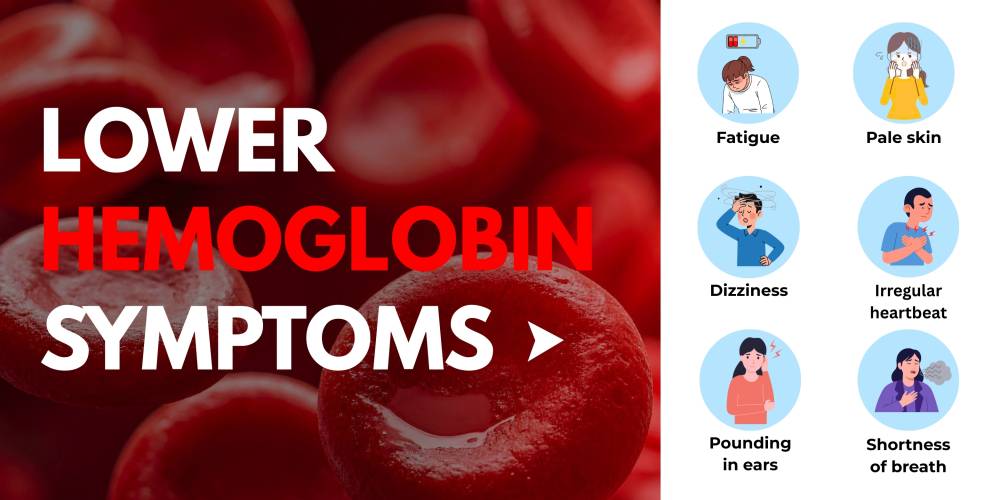
Your body sends clear signals when it’s not getting enough oxygen. **Simply put, low hemoglobin means your blood can't carry sufficient oxygen, which is the root cause of all these symptoms.
The most common signs of low hemoglobin include:
These low hb symptoms are your body's alarm system. Symptoms of low hemoglobin in females can sometimes be mistaken for other issues, especially if the decrease is gradual.
Understanding the cause of low hemoglobin is key to fixing it. The drop usually happens for a few main reasons
|
Common Nutritional Deficiencies |
Blood Loss |
Underlying Health Conditions |
|
The most common reason is a deficiency in essential building blocks like iron, vitamin B12, or folate. Your body needs these to make hemoglobin. |
Hemoglobin can drop if your body is losing blood, which can occur from heavy menstrual periods, a bleeding ulcer, or other internal issues. |
Certain chronic diseases or bone marrow problems can affect your body's ability to produce red blood cells. If tests show your levels are consistently low, consulting a doctor to find the root cause is essential. |
In essence, this is how hemoglobin decreases your body either isn't making enough, is losing it, or is destroying red blood cells faster than it can replace them.If tests show your hemoglobin levels are consistently low, it's essential to consult a doctor to find the definitive root cause, as it could be linked to specific types of anemia.
A significant drop in hemoglobin often points to anemia such as Iron-Deficiency Anemia i(due to lack of iron, which your bone marrow needs ),Pregnancy-Related Anemia (when body's demand for iron significantly increases),Vitamin-Deficiency Anemia i(caused by low levels of nutrients like Vitamin B12 or folic acid),Sickle Cell Anemia (where abnormal hemoglobin makes red blood cells rigid and blocking small blood vessels.)
Ignoring low hemoglobin means more than just putting up with fatigue; it can quietly reshape your daily life. A hemoglobin deficiency makes it difficult to concentrate at work or school and can leave you without the energy for simple daily tasks. Over time, this forces your heart to work much harder to deliver oxygen, creating extra strain that may lead to serious complications like an enlarged heart or heart failure.
The good news is that this path is entirely preventable, and it all starts with one simple step: getting tested. For decades, this meant a painful needle prick and an anxious wait for lab results. Today, however, modern healthcare provides a better, kinder answer.
EzeRx a pioneering Indian health-tech company, that revolutionized this with its flagship innovation the EzeCheck device a portable, best bloodless home HB test kit that provides accurate hemoglobin readings in under 60 seconds without a single drop of blood. It has become the trusted best bloodless hb test kit for individuals and professionals alike.
The core credibility of EzeCheck comes from its rigorous scientific validation. The EzeCheck HB test kit is an ICMR & RMRC clinically validated device. This official endorsement from India's premier medical research bodies means it meets the highest standards of accuracy, making it a reliable alternative to conventional blood tests.EzeCheck serves as a key tool in major public health initiatives like Anemia Mukt Bharat and has been deployed in government programs (such as RBSK and POSHAN Abhiyan) and CSR partnerships with leading corporations like Tata Consultancy Services.Notably, in initiatives like the Swasth Nari and Sashakt Parivar Abhiyan, it has screened over 2.5 lakh individuals respectively.
Choosing EzeCheck means choosing a smarter approach to health. It is Truly Bloodless & Pain-Free, using a painless light sensor perfect for children, the elderly, or frequent monitoring. It's Fast & Hospital-Grade Accurate, delivering lab-comparable results in under a minute, making it the hospital best choice for HB test. Its Unmatched Convenience comes from a portable design that works anywhere, in a clinic, or at a community health camp.
Q1. What is the normal range for hemoglobin?
Answer - For adult men, it's 13.8-17.2 g/dL. For adult women, it's 12.1-15.1 g/dL. Levels below these indicate low hemoglobin.
Q2. What are the main symptoms of low hemoglobin?
Answer - The most common symptoms are severe fatigue, weakness, pale skin, shortness of breath, dizziness, and cold hands or feet.
Q3. What causes hemoglobin to drop?
Answer - The most common causes are nutritional deficiencies (like iron or B12), blood loss (from periods or ulcers), and certain chronic diseases.
Q4. What happens if low hemoglobin is not treated?
Answer - Untreated, it can lead to worsening fatigue, heart problems like arrhythmia or heart failure, and complications in pregnancy.
Q5. How can I increase my hemoglobin levels?
Answer - Treatment depends on the cause. It often includes dietary changes (more iron-rich foods like spinach and lentils), supplements (iron, B12), or treating the underlying medical condition. Always follow a doctor's advice.
Q6. How is hemoglobin tested?
Answer - It can be tested via a traditional blood draw or with a modern, bloodless hemoglobin test l like the EzeCheck device, an ICMR & RMRC clinically validated solution, which uses a painless light sensor on the fingertip.
