
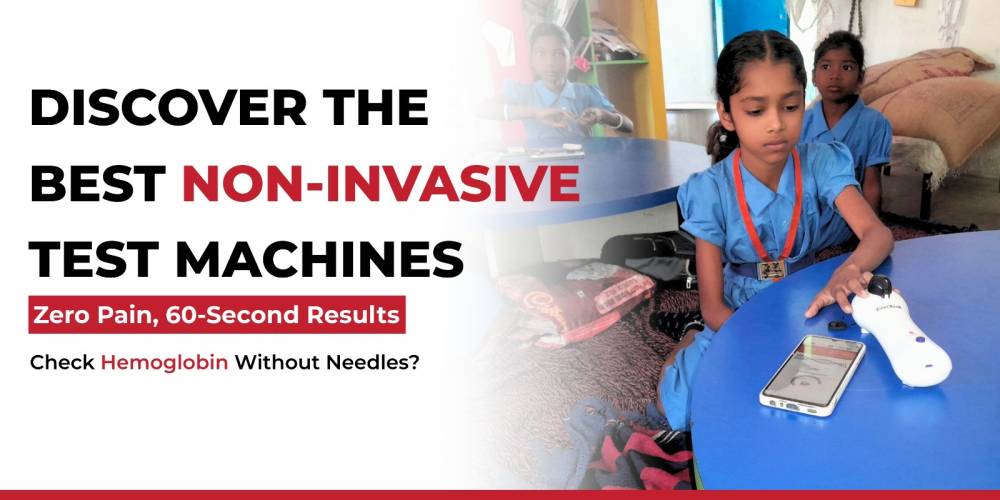
Hemoglobin test machines have revolutionized how we monitor one of the body's most vital health parameters. Among these innovations, the non-invasive blood test device for hemoglobin represents the single biggest advancement in anemia screening technology eliminating needles, pain, and fear from a test that millions avoid precisely because of these factors. Whether you are a healthcare provider seeking efficient screening tools, a CSR professional planning rural health camps, or someone who simply wants to track their hemoglobin levels without the anxiety of finger pricks, understanding these devices is essential. This comprehensive guide explores everything from the fundamentals of hemoglobin and causes of deficiency to how modern non-invasive technology works, with practical strategies for improving your levels quickly.
Understanding Hemoglobin: The Oxygen Carrier in Your Blood
Hemoglobin is a complex protein molecule found inside red blood cells. Its primary physiological function is oxygen transport binding oxygen in the pulmonary capillaries and releasing it in the peripheral tissues. Each hemoglobin molecule can carry four oxygen molecules, making it essential for cellular respiration and energy production.
A healthy hemoglobin range varies by age, sex, and physiological status. According to the World Health Organization, normal reference values are:
Adult males: 13.8 to 17.2 g/dL | Adult females: 12.1 to 15.1 g/dL | Children: 11 to 16 g/dL depending on age | Pregnant women: ≥11 g/dL
When healthcare providers recommend a hemoglobin check, they are essentially evaluating the blood's oxygen-carrying capacity. This single parameter provides critical insights into overall health status.
What Causes Hemoglobin to Drop?
Hemoglobin levels decline when the body's production cannot keep pace with loss or destruction. The etiological factors fall into three main categories:
1. Nutritional Deficiencies
2. Blood Loss
3. Increased Destruction or Decreased Production
What Happens When Hemoglobin is Low? (Signs of Anemia)
When hemoglobin drops below normal ranges, the body's tissues receive insufficient oxygen a condition called hypoxia. The clinical manifestations vary with severity and onset speed.
Mild anemia (10–12 g/dL): Often asymptomatic. Some individuals report fatigue during physical exertion.
Moderate anemia (8–10 g/dL):
Severe anemia (<8 g/dL):
In children, chronic anemia impairs growth and cognitive development. In pregnant women, it increases risks of preterm delivery, low birth weight, and maternal mortality.
How Do You Check Hemoglobin? The Old Way (Finger Pricks)
Conventional hemoglobin testing requires blood sampling. The reference method remains the complete blood count (CBC) analyzed in laboratory settings.
Traditional methods include:
Venipuncture: Blood drawn from a vein, sent to laboratory for analysis. Results take hours to days. Requires trained phlebotomists, sterile equipment, and laboratory infrastructure.
Finger-prick capillary sampling: Blood obtained via lancet, analyzed by portable hemoglobinometers (HemoCue, etc.). Faster than venipuncture but still invasive.
Limitations of traditional testing:
The Future is Here: How to Use a Non-Invasive Blood Test Device
EzeCheck by EzeRx represents a paradigm shift in hemoglobin assessment. This non-invasive hemoglobin meter eliminates needles entirely, using optical sensor technology to measure hemoglobin through the fingertip.
What is EzeCheck?
EzeCheck is India's first ICMR-validated, IoT-enabled non-invasive hemoglobin meter. It is a portable, Class B medical device designed for mass screening in diverse settings hospitals, schools, rural health camps, and CSR initiatives.
Key technical:
How EzeCheck Works: The Technology
Safety certifications: ISO 13485 | IEC 60606-1 and IEC 60606-1-2 | ISO 10993 | US FDA 510(k)
Why EzeCheck is Different
|
Feature |
Traditional Blood Tests |
EzeCheck |
|
Sample required |
Blood draw (venous or capillary) |
Contactless, non-invasive |
|
Pain |
Yes needle prick |
Zero pain |
|
Result time |
Hours to days |
<60 seconds |
|
Consumables |
Lancets, strips, reagents, tubes |
None zero recurring cost |
|
Biohazard waste |
Sharps, contaminated materials |
None |
|
Operator training |
Required (phlebotomy skills) |
Minimal any health worker |
|
Portability |
Limited (lab-dependent) |
Highly portable, handheld |
|
Power requirement |
Continuous |
Battery-operated, single charge lasts hundreds of tests |
|
Data integration |
Manual entry |
IoT-enabled, real-time cloud upload |
Where EzeCheck is Used
EzeCheck is validated for use across the healthcare spectrum:
Real-World Impact: The Numbers
As of March 2025, EzeCheck has powered a nationwide transformation in preventive healthcare:
|
Metric |
Impact |
|
Total screenings |
3.52 million+ |
|
Trusting organizations |
427+ |
|
Global reach |
13+ countries |
|
Blood saved |
6,075+ litres |
|
Medical waste reduced |
15+ tons |
|
Cost savings generated |
$97.5 million+ |
|
Carbon emissions reduced |
46+ kilotons |
|
Healthcare time saved |
1,064+ years |
During the Swasth Nari Anemia Testing Campaign in Odisha, EzeRx conducted over 2.5 lakh screenings. Beneficiaries school children, Anganwadi kids, pregnant women who previously avoided testing due to needle fear, now participate willingly.
Testimonial from the field: "The provided EzeCheck device from the company is very valuable from which our children are getting immense benefits. There is no pain during the testing, which is a very big thing as initially the devices which we were using was taking blood for the test and students were fearing but in this device since no blood sample is drawn for which our students are very much happy as blood is not drawn and there is no pain. Even the test results are good so we are saving time, money and even blood. So, we would like to thank EzeCheck company for making such an important and valuable thing." — Dr. Mandakini Dash, District Ganjam
How to Increase Hemoglobin in a Week (Fast Natural Tips)
While raising hemoglobin significantly in one week requires addressing the underlying cause, dietary interventions can support rapid improvement, particularly in nutritional deficiency anemias.
Week-Long Dietary Plan for Hemoglobin Support
|
Day |
Vegetables (Iron-Rich) |
Fruits (Vitamin C for Absorption) |
Non-Veg Options (Heme Iron) |
How It Helps |
|
Monday |
Spinach (3.6 mg iron per 100g) + Beetroot |
Orange (70 mg Vitamin C) |
Chicken liver (13 mg iron per 100g) |
Spinach provides non-heme iron; orange Vitamin C boosts absorption 6-fold |
|
Tuesday |
Fenugreek leaves (Methi) + Peas |
Guava (228 mg Vitamin C) |
Mutton (3.5 mg iron per 100g) |
Fenugreek contains iron and folic acid; mutton provides heme iron (25-35% absorption) |
|
Wednesday |
Broccoli + Kale |
Kiwi (93 mg Vitamin C) |
Fish (Sardines, Mackerel) |
Broccoli has iron and folate; kiwi Vitamin C enhances non-heme iron uptake |
|
Thursday |
Drumstick leaves (Moringa) + Pumpkin |
Papaya (62 mg Vitamin C) |
Eggs (1 mg iron per egg) |
Moringa is iron-dense (4 mg/100g); eggs provide easily absorbable iron |
|
Friday |
Amaranth leaves (Chaulai) + Green beans |
Strawberries (59 mg Vitamin C) |
Chicken breast (1 mg iron per 100g) |
Amaranth contains iron and folate; strawberries provide absorption boost |
|
Saturday |
Beetroot + Carrots |
Lemon juice (over salad/vegetables) |
Organ meats (Heart, Kidney) |
Beetroot improves hemoglobin synthesis; lemon juice maximizes iron absorption |
|
Sunday |
Mixed vegetable soup (spinach, tomato, beetroot) |
Pomegranate (antioxidants + iron) |
Red meat (beef, lamb) |
Pomegranate provides iron and improves hemoglobin production |
Critical Nutritional Principles
Why EzeCheck is the Future of Hemoglobin Testing
Anemia remains one of India's most pressing public health challenges. According to NFHS-5 (2019–21), 67% of children and over 50% of women are anemic. Traditional testing methods with their needles, pain, and logistical requirements simply cannot achieve the screening scale needed to address this crisis.
For government programs, CSR initiatives, healthcare institutions, and families, EzeCheck represents not just a product but a pathway to an anemia-free population. Ready to transform your anemia screening program? EzeRx supports bulk deployments, health worker training, and program integration. Contact EzeRx through their website to learn how EzeCheck can power your healthcare initiative whether you're a government body, hospital administrator, NGO, or CSR leader.
Frequently Asked Questions About Hemoglobin Test Machine
Q1.Can I check my hemoglobin without a needle?
Answer: Yes. EzeCheck by EzeRx is a clinically validated non-invasive hemoglobin meter that measures hemoglobin through the fingertip using optical sensor technology. No blood, no pain, no needles results in under 60 seconds.
Q2.Is there a hemoglobin check machine that doesn't need blood?
Answer: Absolutely. EzeCheck is India's first ICMR-validated non-invasive hemoglobinometer. It requires zero blood samples, zero consumables, and zero sharps. Just place the finger on the sensor for a complete hemoglobin assessment.
Q3.How accurate is a hemoglobin test machine compared to lab tests?
Answer: EzeCheck demonstrates 93% accuracy compared to the gold-standard CBC test, with >95% sensitivity and specificity. It is clinically validated by ICMR-RMRC and multiple peer-reviewed institutions, making it reliable for both screening and clinical use.
Q4.Which hemoglobin check machine is the best for home use?
Answer: EzeCheck is the optimal choice for home use portable, battery-operated, and extremely simple to operate. It requires no training, no blood, and no recurring consumable costs. Results appear digitally within 60 seconds.
Q5.Can I use a hemoglobin test machine for my kids?
Answer: Yes. EzeCheck is 100% contactless and pain-free, making it ideal for children who fear needles. School health programs across India use EzeCheck for mass pediatric screening children participate willingly without anxiety.
Q6.How do I use a portable hemoglobin check machine?
Answer: Using device like EzeCheck is simple: 1) Power on the device, 2) Log into the mobile app, 3) Enter patient details, 4) Enable Bluetooth, 5) Place the patient's clean ring finger on the sensor, 6) Hold steady for 60 seconds, 7) Read the hemoglobin result on the screen. Data automatically uploads to the cloud for tracking.
