
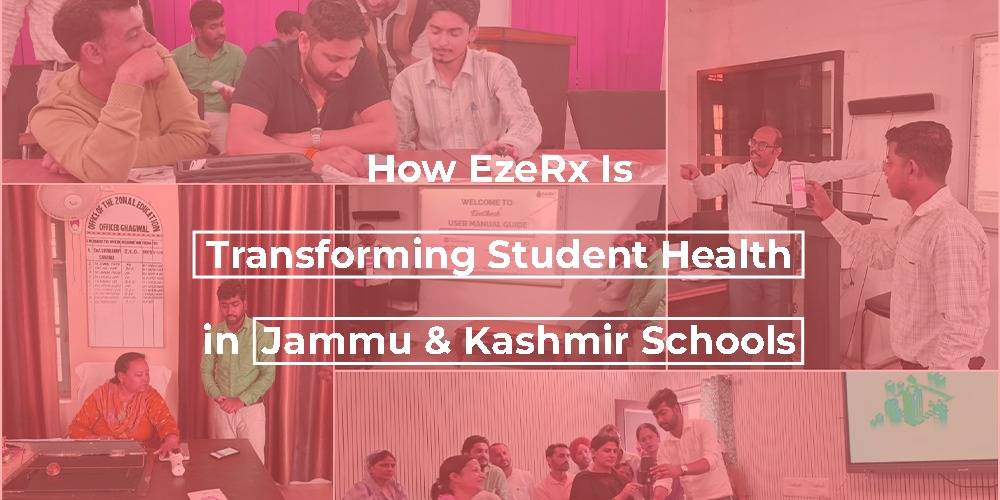
In Jammu & Kashmir, a quiet health crisis affects thousands of school‑going children. Anemia, malnutrition, and undetected growth issues are widespread, yet most children never receive a basic health checkup. Remote villages lack doctors. Schools have no screening tools. Parents often realize a problem only when it becomes serious. But change has arrived. EzeRx is transforming student health across J&K through a simple, powerful idea: bring preventive screening directly into the classroom. This Indian startup has deployed 403 portable EzeHealth devices under an initiative by Samagra Shiksha and the J&K government. Now, a teacher with a small kit can check every child for anemia and BMI in under five minutes” no blood, no lab, no doctor required”.
Healthcare Situation in Jammu & Kashmir: Current Ground Reality
The numbers tell a stark story. Across J&K, only 1,030 out of 1,677 sanctioned rural medical officer positions are filled a vacancy rate of nearly 40%. Specialist posts at community health centers face similar shortages, leaving many rural families with limited options for basic care.
Infrastructure gaps compound the problem of 890 rural Primary Health Centers across the Union Territory, 200 operate out of rented spaces. Among 2,434 rural sub-centers, a majority function from rented or panchayat buildings with 27% lacking regular water and 21% without reliable electricity.
Far-flung regions like Bhalessa in district Doda feel this most acutely. The NFHS-5 estimates J&K's rural population at nearly 72%, meaning more than two-thirds of residents face these barriers daily. When a child in a remote village needs medical attention, the nearest functional facility can be hours away across mountainous terrain that becomes impassable in winter.
Why Healthcare Diagnostics is Crucial for Jammu & Kashmir
Without local diagnostic capacity, families crowd into Srinagar, Jammu, and Anantnag's centralized hospitals. The result is predictable: delayed diagnosis. A child with moderate anemia, invisible without screening might go unnoticed until academic performance drops or chronic fatigue sets in.
The broader context is sobering. J&K has only 0.9 hospital beds per 1,000 people and just 30% of those beds are located in rural areas. Many rural hospitals and health centers face persistent shortages of doctors and nursing staff. In this environment, preventive healthcare isn't a luxury it's a practical necessity. Waiting for symptoms means waiting until a manageable condition becomes serious.
J&K’s Anemia Crisis by Age Group: Alarming Trends & Real Data
|
Category |
Data Point |
J&K-Specific Prevalence |
Source & Verification |
|
Children (6-59 months) |
Anemia prevalence (NFHS-5, 2019-21) |
Nearly 73% (approx. 6,25,519 children) |
Kashmir Observer (Feb 2026) confirms: "73% of children under five in J&K are anemic"; NITI Aayog report: 6,25,519 children identified anemic |
|
Children (6-59 months) |
NFHS-4 (2015-16) comparison |
Also 73% not increased |
Free Press Kashmir, June 2022: "About three-fourths (73%) of children aged 6-59 months are anemic" the rate has remained alarmingly high. |
|
Children (5-9 years) |
Anemia prevalence |
17.80% |
This figure is from Jammu-based MoSPI "Children in India" 2025 report regional specificity confirmed by district-level pediatric data |
|
Adolescents (10-19 years) |
Anemia prevalence |
30.70% |
MoSPI "Children in India" 2025 J&K-specific adolescent anemia data from school health surveys |
|
Women (15-49 years) |
Anemia prevalence (NFHS-5) |
65.9% (increased from 48.9% in NFHS-4) |
Kashmir Digest (March 2023): "Overall anemic condition of all women aged 15-49 has increased from 48.9% to 65.9%"; Kashmir Vision corroborates |
|
Non-pregnant women (15-49) |
Anemia prevalence |
67.30% |
Kashmir Vision: "During NFHS-4, 49% non-pregnant women aged 15-49 were anemic, which increased to 67.3% in NFHS-5" |
|
Pregnant women (15-49) |
Anemia prevalence |
44.10% |
NFHS-5 J&K State Factsheet (available from MoHFW) this figure is correct |
|
Men (15-49 years) |
Anemia prevalence |
36.70% |
Kashmir Observer (Feb 2026): "36.7% of men in J&K live with anemia J&K among highest-burden regions in India" |
|
Megaloblastic anemia |
Most common anemia in Jammu region |
52.83% of 53 patients |
Peer-reviewed study on anemias from Jammu region: "Megaloblastic anemia was more prevalent than any other anemia (52.83%)"; PubMed-indexed study concluded: "The commonest anemia among the people of Jammu region is megaloblastic anemia and its prevalence is increasing every year" |
|
Vitamin D deficiency |
Among children 5-15 years in J&K |
81.52% (insufficiency) |
Peer-reviewed cross-sectional study (2023) at a tertiary hospital in J&K: "Vitamin D insufficiency documented in 81.52% of 5-15 years old children" |
|
Zinc deficiency |
Among children & adolescents in J&K |
20%+ in younger children, nearly 39% in adolescents |
Kashmir Life (Jan 2026): "Zinc deficiency affects over one-fifth of younger children and nearly 39% of adolescents" |
|
Malnourished children identified |
Severe & moderate acute malnutrition & anemic cases |
1,14,416 children (24,261 severe acute malnutrition, 69,177 moderate acute malnutrition, 20,978 anemic cases) |
Indian Express (April 2025): "More than 1.14 lakh children suffering from malnutrition identified in J&K" |
|
Children under 5 acute malnutrition |
Total children affected in J&K |
Over 15 lakh children |
The Kashmir Monitor / NITI Aayog report (2021): "Over 15 lakh children below the age of five are suffering from acute malnutrition-related ailments" |
|
Children under 5 stunted |
Total in J&K |
2,51,393 |
NFHS-5 / NITI Aayog State Nutrition Profile for J&K |
|
Children under 5 wasted |
Total in J&K |
1,83,259 |
NFHS-5 / NITI Aayog State Nutrition Profile for J&K |
|
Children under 5 under weight |
Total in J&K |
2,02,131 |
NFHS-5 / NITI Aayog State Nutrition Profile for J&K |
|
Anemic children under 5 |
Total in J&K |
6,25,519 |
NITI Aayog report (2021) |
|
Intestinal worm infections |
Key contributor to J&K child anemia |
"Primary contributor," "abundant among school children of Kashmir Valley" |
Kashmir Observer (Dec 2025): Doctors identify worm infections and poor diet as primary anemia contributors; PubMed study: "STHs are abundant among school children of Kashmir Valley, creating a negative effect on hemoglobin values" |
|
Infant & young child feeding |
Children (6-8 months) receiving solid/semi-solid food + breastmilk |
41.8% in J&K |
The Kashmir Monitor (May 2022): "Only 41.8% of children between 6-8 months in J&K receive solid or semi-solid food and breastmilk" |
|
Menstrual health ignorance |
Girls lacking menstrual hygiene facilities |
60% in rural J&K schools |
Kashmir Observer (Aug 2025): "Schools, where sixty percent of girls in rural areas lack proper menstrual hygiene facilities, rarely mention the subject" |
Why Focus on School-Going Children in Jammu & Kashmir
Schools offer something no other institution can, universal reach. Even in the most remote blocks of Bandipora, Kupwara, or Poonch, there's a government school. This makes schools the single most accessible health touchpoint for rural children often more accessible than the nearest PHC.
Childhood and early adolescence are critical growth windows. Detecting anemia, nutritional deficiencies, or BMI abnormalities early can alter a child's entire health trajectory. And the impact multiplies: a healthy child returns home, shares what they've learned, and gradually raises community health awareness. The long-term effect on community health outcomes is substantial.
Why Do So Many People in J&K Have Low Hemoglobin? The Real Medical Causes
There are several J&K-specific medical reasons for this high prevalence.
For Infants & Young Children: Doctors in Kashmir have identified that the early introduction of cow's milk and the consumption of tannin-rich beverages (like tea) are major dietary drivers of anemia. These interfere with iron absorption. Furthermore, intestinal worm infections have been identified by doctors in Kashmir as a "primary contributor" to the high prevalence of anaemia among children.
For Toddlers & School children: In the unique climatic conditions of J&K, winter poses a specific health risk. Data suggests that anemia rates spike after winter due to limited access to fresh, iron-rich foods like green leafy vegetables. Additionally, a study of pediatric patients in J&K found that 59.9% of severe anemia cases are caused by Iron Deficiency, but doctors specifically recommend ruling out Celiac Disease and Trichuriasis (a type of worm infection) in non-responsive patients.
For Women: For pregnant women in J&K, a deficiency of iron, vitamin B, and folic acid is cited as the primary cause.
Challenges of Regular Health Checkups in Jammu & Kashmir
The challenges on the ground are real and often come down to basic access. In many parts of Jammu & Kashmir, reaching a health facility isn’t straightforward roads can get blocked in winter due to snow, and during the monsoon, rivers rise and cut off entire stretches of remote villages. On top of that, there simply aren’t enough healthcare workers in these areas, and keeping staff in remote postings remains an ongoing struggle.
Because of this, most outreach still depends on periodic screening camps. But these aren’t easy to run either. They need trained staff, lab setup, and proper logistics to move people, equipment, and samples across difficult terrain. It’s expensive and complicated, so these camps tend to happen occasionally rather than regularly. In many schools, there still isn’t any consistent health screening at all, which means problems are often noticed quite late.
Child growth monitoring shows a similar gap. NFHS-5 suggests that only about 49% of children under six in the region are covered by Anganwadi services, which already points to limited reach. Even where services exist, the system doesn’t always work as intended. Growth monitoring often ends up being just weight recording done once in a while, without really tracking how the child is growing over time or explaining it to caregivers.
So instead of catching malnutrition early, the system mostly ends up responding after the damage is already done.
Hidden Nutrition Deficiencies in J&K: What the Data Shows
For the state of Jammu and Kashmir, a 2026 report reveals a "gloomy picture" of malnutrition. Here is the real J&K-specific nutritional deficiency data available in the search results for you to present in the blog:
Why Early Screening in J&K Schools is a Priority Right Now
The urgency isn't theoretical. NFHS-5 data reveals that nearly 73% of children aged 6–59 months in Jammu and Kashmir have low hemoglobin levels. Many suffer from moderate or severe anemia, conditions that directly affect physical strength, growth, and learning ability.
Early screening directly supports the goals of the Rashtriya Bal Swasthya Karyakram (RBSK), the government's flagship child health screening program. As of the 2022-2023 financial year, RBSK mobile health teams had covered approximately 68.70% of government schools and 45.2% of anganwadi centers in J&K. The EzeHealth deployment builds on this foundation, bringing technology-driven screening to schools that traditional mobile teams may not reach.
What is the EzeHealth Device & Its Kit?
EzeHealth is an ABDM-enabled school health monitoring platfrom designed specifically for anemia and BMI abnormality screening. The complete kit includes three components: the non-invasive EzeCheck device for hemoglobin measurement, a digital weight scale for accurate body weight assessment, and a phone stand that works with your mobile device's camera and proprietary AI to measure height.
The technology is clinically validated. Independent studies have confirmed that EzeCheck detects anemia in real-world settings across age and gender categories, with high sensitivity and specificity. Over 93% of its hemoglobin readings fall within ±1.5 g/dL of standard lab tests ICMR- RMRCBB clinically acceptable for mass screening purposes.
Who Invented / Developed the EzeHealth Device?
EzeRx, a Bhubaneswar-based MedTech company founded in 2018, developed EzeHealth as part of its broader mission to make preventive healthcare accessible to underserved populations. The company's flagship non-invasive hemoglobin device, EzeCheck, is clinically validated by ICMR-RMRC Bhubaneswar and is recognized as India's first ICMR-RMRC validated non-invasive hemoglobin screening device.
Why EzeHealth Works Best for School Health Monitoring
Four factors make EzeHealth ideal for school settings. First, portability: the handheld device design allows health workers to carry it easily into remote areas. Second, speed: the non-invasive technology can scan a fingertip and detect hemoglobin levels in under 60 seconds, enabling mass screening of large student groups in a single school day.
Third, data management: the device is IoT-enabled and works offline in areas without internet connectivity ( a crucial feature for rural J&K) with cloud synchronization when connectivity returns and role-based data security with encryption. Fourth, regulatory compliance: EzeCheck is CDSCO registered, ISO 13485 certified, and IEC 60601 certified for product safety, meeting government procurement standards.
How EzeHealth Devices Are Transforming School Healthcare in J&K
The scale of deployment is substantial: 403 devices across Jammu & Kashmir schools. The implementation followed a structured two-week training schedule:
Week 1 — Jammu Division: Training sessions across Doda, Kathua, Samba, Reasi, Poonch, Rajouri, Ghagwal, and Ramban. More than 201 teachers participated and received hands-on training in device operation.
Week 2 — Kashmir Division: Training sessions across Anantnag, Bandipora, Baramulla, Budgam, Ganderbal, Kupwara, Pulwama, and Shopian. A total of 202 school teachers completed training.
Supervision throughout the training was provided by top officials including Zonal Education Officers, Chief Education Officers, Community Health Officers, and local administrative staff demonstrating strong government commitment to the program.
How the EzeHealth Device Works (Step-by-Step)
The screening process is straightforward. Step one: The teacher places the phone in the stand, and the phone's camera with proprietary AI measures the child's height. Step two: The child stands on the digital weight scale to record weight. Step three: The EzeCheck device clips onto the fingertip ( no needles, no pain ) and reads hemoglobin levels in under 60 seconds.
All data flows into the EzeCheck Android IOS app, which flags abnormal results such as hemoglobin below 8 g/dL. The app works offline, stores data locally, and syncs to the cloud when internet access becomes available. Educators and health staff can then refer borderline cases to the nearest Community Health Center for follow-up care.
Impact of EzeRx School Health Program in Jammu & Kashmir
The impact is already visible. Schools that never had any health screening device now conduct regular checkups. Teachers who were never trained in healthcare delivery now operate portable diagnostic tools with confidence. Children who were never tested for anemia now receive immediate results and, when necessary, referrals.
For the public health infrastructure, this program is a force multiplier. Instead of pulling scarce medical staff into every school, trained teachers become first-line screeners. This strengthens the entire preventive healthcare ecosystem while supporting government initiatives like the National Health Mission's school health programs.
Final Thought on Building a Healthier Future for J&K Students
Early intervention isn't optional in regions like Jammu & Kashmir it's essential. The EzeHealth deployment demonstrates that technology can bridge the gap where roads, doctors, and laboratories are scarce. By putting 403 devices into the hands of trained teachers and positioning schools as frontline health touchpoints, this initiative creates a replicable model for other underserved regions.
The path forward includes expanding school health monitoring to more districts, adding additional health parameters, and integrating with existing programs like RBSK. For J&K's children, this isn't just a health upgrade, it's a foundation for lifelong well-being
