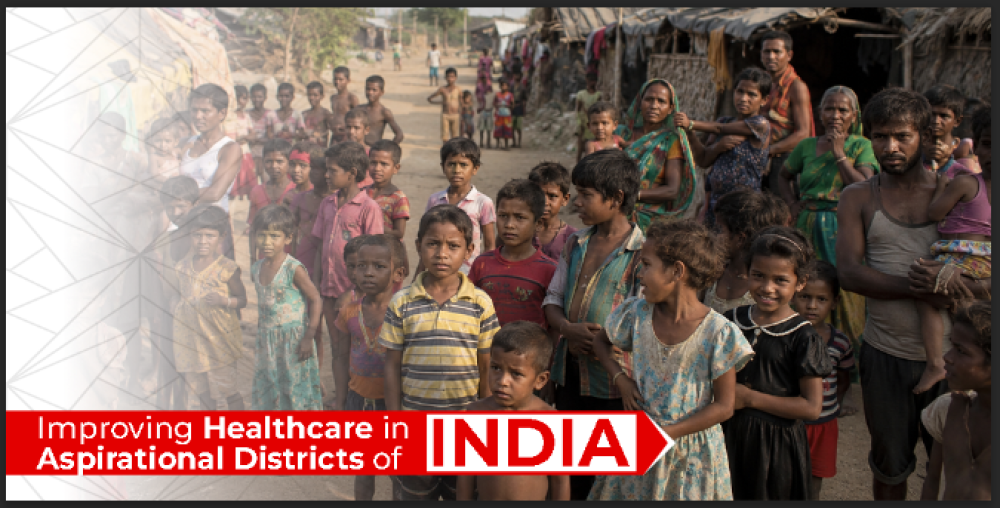
When we talk about healthcare in India, we often hear about big hospitals in cities. But what about villages and small towns? That’s where the real challenge lies. The Government of India started a special program called the Aspirational Districts Programmed to help the country’s most underdeveloped districts catch up. Odisha is one of the important states in this program, with ten districts working hard to improve health, education, and basic facilities.
In places like Kalahandi, Odisha, people face problems like few doctors, long distances to clinics, and delayed treatment. But new digital tools are beginning to change that. One such tool is EzeCheck, a smart device that helps healthcare workers do their job faster and better. This blog looks at how EzeCheck is making a real difference in Kalahandi and what it means for the future of healthcare in India’s aspirational districts.
What are Aspirational Districts in India?
Aspirational Districts are those areas of India that have shown relatively less progress in key social areas compared to the rest of the country. The Government of India created this category in January 2018 under NITI Aayog. Instead of waiting for slow, top‑down change, the government wanted to focus special attention on 112 districts across the country.
These districts are measured on 49 key indicators spread across five themes. The most important theme is Health & Nutrition, which carries the highest weightage of 30%. The other focus areas include Education, Agriculture & Water Resources, Financial Inclusion & Skill Development, and Basic Infrastructure.
Think of it like this, in every classroom, some students need a little extra help to reach the same level as others. Aspirational Districts are those “students” of India. They get extra support, better monitoring, and a healthy dose of competition with each other to improve quickly. The strategy is simple but powerful Convergence (all government schemes work together), Collaboration (central and state teams partner closely), and Competition (districts compete to rank higher). This approach has already shown real results in many places.
Healthcare Situation in Aspirational Districts of Odisha
Odisha is a state with a large rural and tribal population. Out of its 30 districts, ten are classified as aspirational districts. These include Kalahandi, Balangir, Dhenkanal, Gajapati, Kandhamal, Koraput, Malkangiri, Nabarangpur, Nuapada, and Rayagada. More than 80% of Odisha’s 4.5 crore people live in rural areas, and a significant portion belongs to tribal communities.
The healthcare challenges here are not small. Across these ten aspirational districts, there are about 2,396 primary healthcare facilities and to understand the full scale, consider anemia one of the most common but preventable health problems. Across Odisha, 64.2% of children aged 6 to 59 months are anemic, according to the National Family Health Survey (NFHS‑5, 2019‑2021). Among women aged 15 to 49 years, the number is 64.3% . Even men are affected – 28.5% of men in Odisha have low hemoglobin. These numbers are not just statistics; they represent millions of people living with fatigue, weakness, and increased risk of infection.
Another major issue is distance. Many villages are located in hilly or forested areas. A person in Thuamul Rampur block of Kalahandi has to travel 50 kilometers to reach the nearest primary health centre. When someone is sick, that kind of distance often means delayed treatment or no treatment at all. Families lose wages, children miss school, and small health problems turn into big emergencies. Delayed diagnosis is a silent killer in these areas. Without quick access to testing and doctors, diseases like anemia, malaria, and high blood pressure go unnoticed until it’s too late. Improving the primary healthcare system in these districts is not just a government target it is a matter of life and death for thousands of families.
Why Healthcare Improvement is Needed in Places Like Kalahandi
Kalahandi was once known in the news for poverty and hunger. Today, it is still one of the most backward districts in Odisha, but things are slowly changing. As an aspirational district, Kalahandi has received special attention under the ADP. However, when you look at healthcare, the gaps remain huge. The district is home to many remote villages and a predominantly tribal population. These communities often live far away from paved roads and electricity connections. Specialists like gynecologists, pediatricians, and surgeons are almost impossible to find outside the district headquarters town of Bhawanipatna. Even there, the availability is limited.
The real‑life impact of this is heartbreaking. A pregnant woman in a remote village may not get her hemoglobin checked regularly. If she becomes severely anemic, she might need a blood transfusion at the nearest facility with these services could be hours away. Similarly, a child with fever might be treated as a simple viral infection when it is actually malaria, because no one did a blood test.
Travel burden is another huge cost. Families often sell livestock or borrow money just to take a sick relative to a town hospital. By the time they reach, the disease may have progressed too far. This is why healthcare improvement is not a luxury in Kalahandi, it is an urgent necessity.
To understand the scale of the problem, let’s look at the numbers. Kalahandi has a population of 1.58 million people, and over 92% of them live in rural villages many without all-weather roads or reliable electricity. According to the National Family Health Survey (NFHS‑5, 2019‑2021), the situation is alarming. Among children aged 6 to 59 months in Kalahandi, 70.2% are anemic far above the national average of 57%. For pregnant women, the number is even worse 70.2% have anemia. This is not just a number; it means that seven out of every ten expecting mothers are at higher risk of bleeding, stillbirth, or losing the baby, worse part the situation is deteriorating. In the previous NFHS survey (NFHS‑4, 2015‑2016), only 44.6% of children in Odisha were anemic. That number has since jumped to 64.2% a shocking increase of nearly 20 percentage points in just five years. This means the anemia crisis is not stable or improving; it is actively getting worse. That is why a tool like EzeCheck, which can screen hundreds of people in a single day without needles or labs, is no longer a nice‑to‑have. It is an urgent necessity.
Malnutrition makes everything harder. In Kalahandi, one in three children (31%) is stunted meaning they are too short for their age due to chronic undernutrition. Another 17% are wasted (too thin for their height), and 6% are severely wasted, which requires emergency care. Only 16% of children between 6 and 23 months receive an adequately diverse diet. That means nearly 84% of toddlers are not getting the iron-rich foods they need to build healthy blood. Among adults, 23.8% of women in Kalahandi have a low body mass index (BMI below 18.5) a clear sign of chronic hunger and nutrient deficiency.
What is EzeCheck? (Simple Introduction)
EzeCheck is a non‑invasive portable device that checks a person’s hemoglobin level without taking a single drop of blood. It is about the size of a small remote control and runs on battery. The person simply places a fingertip on a small sensor, and within less than one minute, the device shows the hemoglobin reading on a screen.
How does it work? The device uses a technology called spectrophotometry combined with AI and machine learning algorithms. In simple words, it shines a specific light through the fingertip, measures how the light changes, and calculates the hemoglobin level. It is accurate enough to be used in government health programs.
EzeCheck was developed by EzeRx Health Tech Pvt. Ltd. , a medical technology company and designed it specifically for resource‑constrained settings meaning places with no labs, no electricity for long hours, and no trained phlebotomists to draw blood.
Why are digital tools like EzeCheck important in rural healthcare?
Because they solve three big problems at once. First, they remove the need for needles and blood samples, which many people fear. Second, they give instant results, so patients don’t have to wait days or travel again. Third, they can store data digitally, which helps health workers track patients over time. For a place like Kalahandi, this is a game changer.
Impact of EzeCheck in the Healthcare System
When a tool like EzeCheck enters a public health system, the benefits go far beyond just measuring hemoglobin. Here’s how it improves healthcare delivery in a real, practical way:
Faster patient registration and screening: Earlier, a health worker would have to prick a finger, collect blood, process it on a portable machine, and then write the result by hand. With EzeCheck, the entire process takes under a minute. This means more people can be screened in the same amount of time.
Better data management: The device can store patient readings and even sync them to a phone or tablet. This allows health workers to see if a patient’s hemoglobin is dropping over time, which helps in early detection of severe anemia.
Reduced paperwork: Government health programs generate tons of paper forms. EzeCheck’s digital output reduces the need for manual entries, which also reduces errors.
Easier monitoring of patients: A frontline worker like an ASHA can visit a village, screen a dozen pregnant women in one hour, and instantly know who needs iron supplements and who needs urgent referral.
Helps doctors and health workers work better: Doctors at a primary health centre can see the digital records of patients coming from remote sub‑centres. They don’t have to repeat tests, and they can make faster decisions.
Improves government health program tracking: Programs like the Anemia Mukt Bharat (Anemia Free India), require regular screening of vulnerable groups. EzeCheck provides reliable, real‑time data that helps district officials know exactly where the problem is worst.
A peer‑reviewed study published in PLOS Digital Health (2024) concluded that EzeCheck performs well across all age groups and genders, with high sensitivity and accuracy. The study found no significant bias compared to standard laboratory analyzers. That kind of scientific backing matters when you are introducing a new tool in public health.
Impact of EzeCheck in Kalahandi, Odisha
Now let’s zoom in on Kalahandi. How does a device like EzeCheck help in a district with poor roads, few doctors, and scattered villages?. First, it brings better access to patient data even in remote areas. An ASHA worker or a nurse at a sub‑centre can carry EzeCheck in her bag. She can screen villagers right where they live, without asking them to travel. Now consider WHO information that 70% anemia really means for a village. In a typical hamlet of 200 people, roughly 30 children and 40 women of childbearing age would be anemic. Without EzeCheck, a health worker would have to guess who needs help, or rely on visible signs like pale eyelids, which appear only when anemia is already severe. With EzeCheck, the same worker can screen every single person in that village in less than two hours. She gets an exact hemoglobin number for each person. That number tells her who needs only dietary advice, who needs iron tablets, and who must be rushed to a primary health centre for a blood transfusion. This is the difference between a child fainting in class and that same child staying healthy enough to attend school.
Second, it improves coordination between health centers. A sub‑centre can share digital hemoglobin records with the nearest primary health centre. If a patient needs follow‑up, the doctor already knows the history. This reduces duplication of work and speeds up referrals.
Third, it helps reduce delays in treatment. Anemia is extremely common in tribal areas due to poor nutrition. If a pregnant woman is found to have severe anemia (hemoglobin below 7 g/dL), she needs immediate treatment. With EzeCheck, that detection happens in minutes instead of days. That can literally save the life of both mother and baby.
Fourth, it supports frontline health workers who often work alone with little support. Instead of feeling helpless because they have no diagnostic tool, they now have a reliable device that gives them confidence. They can explain to the patient “See this number? This is your blood level. It is low, so you must take these iron tablets.”
In January 2025, EzeRx partnered with an organization called Kalinga Kusum in Kalahandi to screen hundreds of individuals for anemia. This was a real, on‑ground deployment. Such pilots show that the technology is not just a lab dream it is working in the same villages where people struggle to get basic care.
Over time, as more health centres in Kalahandi adopt EzeCheck, the entire healthcare system becomes step‑by‑step stronger. It is not a magic wand, but it is a very practical ladder.
Challenges Still Remaining
It would be wrong to say everything is perfect now. Kalahandi and other aspirational districts still face serious hurdles and the challenge is made worse by the sheer scale of need. Odisha as a state has an anemia rate of 64% among women and children, and over 80% of its 4.5 crore people live in rural areas. In Kalahandi specifically, only 199 out of 606 sanctioned doctor posts are filled. That means one doctor is available for roughly every 7,950 people and most of those doctors are concentrated in the town of Bhawanipatna, not in the villages where 92% of the population lives. Without digital tools like EzeCheck, that doctor-to-patient ratio would be impossible to manage for anemia screening alone. The simple message is this progress is happening, but slowly. The government is aware of these challenges. Programs like the Sampoornata Abhiyaan (a three‑month campaign from July to September 2024) were trying to saturate key health indicators across aspirational districts.
Future of Healthcare in Aspirational Districts
The future looks brighter than the past. The government is increasingly focusing on digital health systems. For example, the Ayushman Bharat Digital Mission (ABDM) pilot began in Keonjhar district of Odisha in January 2026, with plans to roll it out across the state. ABDM will allow digital appointment booking, referrals, and follow‑ups all linked to a unique health ID for every citizen.
Odisha has also launched the ‘Ama Hospital’ scheme (meaning “Our Hospital” in Odia) with a budget of over ₹3,300 crore for the period 2023‑28. Under this scheme, 1,858 hospitals are being upgraded with better infrastructure, equipment, and digital systems.
Technology like EzeCheck will play a growing role. The Odisha government has already integrated EzeCheck into the Rashtriya Bal Swasthya Karyakram (RBSK) , which screens school children. It has been deployed across all 30 districts of Odisha , screening over 3 lakh children in a short time. Nationally, EzeCheck has screened more than 6.5 million people to date, saving over 6,000 liters of blood and avoiding 46 kilotons of carbon emissions by reducing biomedical waste.
For aspirational districts like Kalahandi, the hope is that these technologies will become routine, not special. A government health worker should be able to check hemoglobin, blood pressure, blood sugar, and other parameters at the village level using simple, portable devices. When that day comes, the distance to a hospital will no longer mean a death sentence.
