
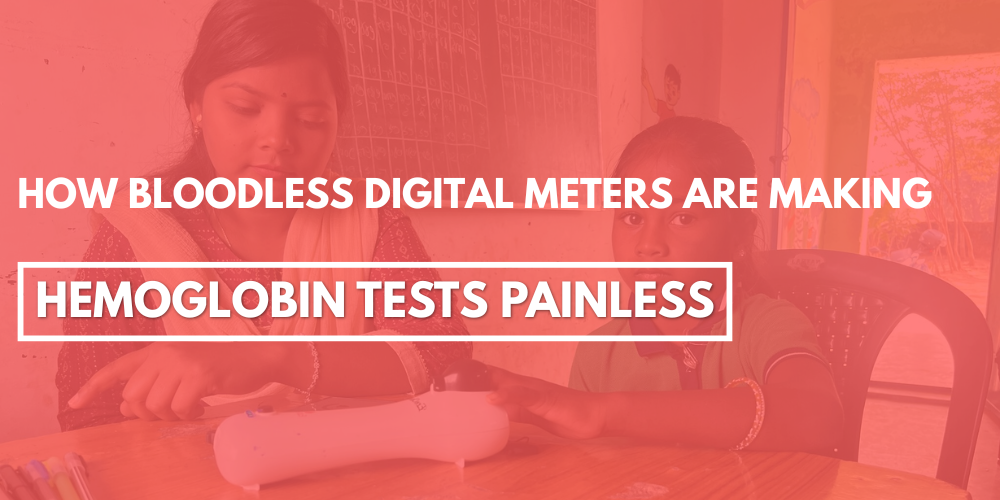
Remember the last time you needed a blood test. That slight pinch. The wince. The momentary dread as the needle approached your fingertip. For millions of Indians, that moment is enough to postpone health checkups indefinitely. Now imagine placing your finger on a small device and walking away sixty seconds later with your hemoglobin result a complete bloodless digital hemoglobin meter. No prick. No blood. No fear. This isn't a distant future scenario. It's happening right now across India, from the corridors of district hospitals to the verandas of Anganwadi centers in remote villages.
The Problem We've Lived With For Too Long
For decades, checking hemoglobin meant one thing: a lancet to the finger. A drop of blood. A small but real moment of pain. For children, it often meant tears. For adults, it meant that familiar flinch we've all learned to accept.But the challenges ran deeper than momentary discomfort. Traditional invasive testing created a cascade of practical problems:
Infection risks lurked with every finger prick, especially in settings where sterile conditions couldn't be guaranteed. Biohazard waste accumulated used lancets, alcohol swabs, contaminated gauze requiring careful disposal that many rural facilities couldn't manage properly.
Trained personnel were necessary to draw blood and handle samples, creating bottlenecks in places where healthcare workers were already stretched thin. And perhaps most critically, fear kept people away. When screening requires pain, many simply opt out.
A Gentle Revolution in Preventive Healthcare
Enter bloodless digital meters. These compact devices represent something genuinely new in healthcare: technology that removes the barrier between people and the information they need about their bodies.
The concept is elegantly simple. Instead of piercing skin to draw blood, these meters use light to see what's inside blood vessels. It's non-invasive. It's painless. And increasingly, it's proving itself as a reliable tool for mass screening.
What makes this a true paradigm shift isn't just the absence of pain. It's what that absence enables. When testing stops hurting, people stop avoiding it. When devices don't require specialized training, community health workers can screen thousands. When there's no biohazard waste, screening can happen anywhere a school classroom, a village square, a remote health camp.
What Exactly Is a Bloodless Digital Meter?
Let's clarify what we're actually talking about. A bloodless digital meter clinically referred to as a non-invasive hemoglobin monitor is a medical device that estimates hemoglobin levels without drawing blood.The shift from invasive to non-invasive testing represents one of the most practical innovations in preventive healthcare. Traditional methods required breaking the skin barrier, extracting blood, and often sending samples to labs. The new approach keeps the skin intact while gathering the same essential information. Think of it as the difference between taking a water sample from a river versus measuring the water's properties by looking at it from the bank. Both can tell you something about what's in the water, but one is far simpler to do at scale.
The Working Principle of Digital Hemoglobin Meters
At its core, a digital hemoglobin meter operates on a straightforward principle: different substances absorb and reflect light differently. Hemoglobin, the protein in red blood cells that carries oxygen, has a distinct light absorption pattern.When you place your finger on these devices, specific wavelengths of light pass through your skin and into the tiny blood vessels underneath. The hemoglobin in your blood absorbs some of that light. Sensors on the other side measure how much light passes through. Complex algorithms then convert that optical data into a hemoglobin estimate.
It sounds almost too simple, but the physics is sound. The challenge has always been making it accurate enough for clinical use.
The Science of Spectrophotometry: How Light Becomes Data
To understand how devices like EzeCheck achieve reliable results, we need to look at spectrophotometry the measurement of how light interacts with matter.
When light passes through a fingertip, it encounters multiple layers: skin, tissue, bone, and blood. Each layer scatters or absorbs light differently. The breakthrough technology lies in isolating the signal from just the blood.EzeCheck uses multiple specific light wavelengths, each chosen because hemoglobin absorbs it in predictable ways. Some wavelengths penetrate deeper. Others provide reference points to account for individual variations like skin thickness or melanin content.
Here's where artificial intelligence enters the picture. Raw optical data contains significant "noise" interference from all those non-blood tissues your finger contains. Advanced algorithms filter out this noise, isolating the hemoglobin signal. They've been trained on thousands of data points, learning to recognize patterns that correlate with actual hemoglobin levels.The result transforms complex physics into something beautifully simple: place your finger, wait sixty seconds, receive your result.What makes EzeRx's approach distinctive is the proprietary calibration developed through years of research. The algorithms have been refined against thousands of traditional blood tests, learning to account for the variations that once made non-invasive testing challenging. It's technology built on real-world data, not just laboratory theory.
Why "Painless" Changes Everything
The absence of pain might sound like a convenience, a nice-to-have feature. In practice, it's transformational.
For Children: Screening Without Tears
Anyone who's worked in pediatric healthcare knows the scene. A child sees the needle. The crying starts before anything's happened. Parents hover anxiously. Healthcare workers feel pressured to be quick, which increases error risk.
Needle-free testing changes this dynamic completely. A child places a finger on a device. There's a soft glow from inside. Sixty seconds later, it's done. No tears. No trauma. No negative association with healthcare visits.
Schools across India are now screening students for anemia using this approach. Children who would have hidden or refused to participate now line up curiously. For anemia screening programs targeting adolescents a key demographic where iron deficiency affects concentration and energy levels this changes everything about what's possible.
For Rural Communities: Empowering Local Health Workers
In rural India, trained phlebotomists are scarce. Drawing blood properly requires skill. Handling samples requires cold storage. Transporting them to labs requires reliable transportation. Each requirement creates a bottleneck.
Bloodless meters remove these bottlenecks entirely. ASHA workers, Anganwadi teachers, even trained volunteers can perform screenings after minimal instruction. No syringes. No cold chain. No biohazard disposal concerns.
A health worker can now carry a device in their bag, visit a village, and screen dozens of people in an afternoon. Results appear immediately, allowing for on-the-spot counseling and referrals. For communities where a trip to the district hospital means losing a day's wages, this accessibility matters enormously.
For Hospitals: Cleaner, Safer Work Environments
Hospitals generate staggering amounts of sharps waste. Each lancet, each needle requires careful disposal. Each used item carries potential infection risk for staff.
Non-invasive testing eliminates this waste stream entirely for hemoglobin screening. No sharps containers to fill and replace. No needle-stick injuries to worry about. No biohazard bags to incinerate.
For hospital administrators managing tight budgets, the math works on multiple levels: reduced supply costs, reduced disposal costs, reduced staff training requirements, and improved safety metrics.
The Accuracy Question Everyone Asks
Here's the concern that comes up every time I discuss non-invasive testing with healthcare professionals: "But is it accurate enough?" It's a fair question. We've all been trained to trust the lab report, the printed result from automated analyzers. How can a finger on a plastic box compete with that?
The ICMR Validation
This is where credible evidence matters. EzeCheck holds the distinction of being India's first non-invasive hemoglobinometer validated by the Indian Council of Medical Research (ICMR-RMRCBB). That's not a marketing claim it's a rigorous scientific validation from India's apex medical research body.The validation process involved comparing thousands of readings against gold-standard laboratory methods across diverse populations. Different ages. Different skin tones. Different health conditions. The device had to prove itself against real-world variation.
The Data Behind the Device
The results show clinical-grade accuracy exceeding 93% when compared to Complete Blood Count (CBC) tests, with sensitivity and specificity both above 95%. These aren't ballpark figures—they're numbers that make the device suitable for screening programs where reliable results matter.
Multiple research articles published in peer-reviewed journals document this accuracy. The technology has evolved significantly from early prototypes, with the current generation benefiting from years of algorithm refinement based on real-world usage data.
A Doctor's Perspective
Dr. Meera Sharma, who coordinates anemia screening programs in rural Maharashtra, puts it plainly: "When we first tried these devices, I was skeptical. I'd seen too many 'innovations' that couldn't deliver. But after comparing hundreds of our patients' results with lab tests, I trust them for screening. The correlation is consistent. More importantly, we're screening five times more people than we could with traditional methods. That trade-off slightly less precision for dramatically more coverage is exactly what public health requires."
EzeCheck: India's First ICMR-Validated Non-Invasive Hemoglobinometer
The device making this possible deserves specific attention. EzeCheck emerged from a very personal motivation. Partha Pratim Das Mahapatra, an electronics engineer, watched his mother struggle with undiagnosed anemia a condition that might have been caught earlier with easier screening. That experience seeded an idea: what if checking hemoglobin didn't require a lab visit?
Years of development later, EzeCheck represents the culmination of that vision. It's designed specifically for Indian conditions portable enough to reach remote areas, durable enough for field use, simple enough for community health workers to operate.
What It Offers
Results in sixty seconds. The entire process takes about a minute from finger placement to reading. No waiting for lab reports. No follow-up visits for results.
Zero consumable costs. Traditional testing requires lancets, reagents, swabs, and disposal supplies. Every test adds cost. EzeCheck uses no consumables at all. After the initial device investment, each subsequent test costs effectively nothing.
Portable and battery-operated. It fits in a small bag and runs on battery power. Screening can happen anywhere a schoolroom, a village square, a mobile health van, a remote clinic without reliable electricity.
Digital record-keeping. Results upload automatically to a connected platform, creating searchable records without paperwork. For program managers tracking anemia prevalence across districts, this data integration transforms what's possible in monitoring and evaluation.
The Vision Behind the Device
Partha Pratim Das Mahapatra, Founder of EzeRx, describes the mission simply: "My mother's experience taught me that healthcare access isn't just about having hospitals nearby. It's about removing the barriers that keep people from seeking care. Pain is a barrier. Distance is a barrier. Cost is a barrier. We built EzeCheck to address all three."
That vision extends beyond a single device. EzeRx has developed complementary tools—a non-invasive urine analyzer, a school health monitoring platform but hemoglobin screening remains the foundation. Anemia affects over half of Indian women and children. It saps energy, impairs cognitive development, complicates pregnancy. Addressing it at scale requires tools that work at scale.
Who's Using Bloodless Digital Meters Today?
The adoption patterns tell a revealing story about where this technology fits.
Government Health Missions
EzeCheck has become a tool for state-level anemia elimination efforts. The Himachal Pradesh government integrated it into their health missions. Odisha, Assam, Jharkhand, and Uttar Pradesh have deployed it across districts.
The Anemia Mukt Bharat campaign, India's flagship program to reduce anemia prevalence, represents exactly the kind of large-scale initiative where non-invasive screening makes sense. Testing millions of people requires tools that are fast, affordable, and acceptable to communities.
Specific districts where deployment has occurred Ganjam, Cuttack, Puri, Kalahandi, Rayagada in Odisha, Purnia in Bihar, Sambhal in Uttar Pradesh, Satara in Maharashtra show the geographic spread. From coastal communities to Himalayan foothills, the devices are proving themselves across diverse terrains and populations.
Schools and Anganwadis
Institutional screening programs have embraced the approach. Schools use it for adolescent health programs, identifying students who need nutritional support. Anganwadi centers screen pregnant women and young children during routine visits.
The partnership with organizations like UNICEF, PATH, and the Tata Trusts brings additional credibility and reach. These organizations don't back unproven technology. Their involvement signals confidence in the approach.
Corporate CSR Initiatives
Pharmaceutical companies including Sun Pharma, Cipla, Emcure, and Zydus have incorporated the technology into their community health programs. Corporate social responsibility initiatives focused on maternal and child health find the devices well-suited to their needs portable, measurable, and scalable.
Beyond India's Borders: EzeCheck Has Presence on 13+ Countries
The technology has traveled beyond India to thirteen countries across Asia and Africa. Indonesia, Vietnam, Myanmar, the Philippines in Southeast Asia. Kenya, Tanzania, Malawi, Burkina Faso in Africa.
Each new geography presents different challenges different diets affecting hemoglobin levels, different skin tones, different healthcare infrastructures. The devices have adapted and proven themselves across this diversity.
The Future of Anemia Screening in India
Looking ahead, the trajectory seems clear. Digital health and point-of-care devices aren't a passing trend they're the logical evolution of preventive medicine.
India faces a unique challenge in anemia screening. With a population of 1.4 billion, traditional lab-based testing simply cannot achieve the coverage needed. The infrastructure doesn't exist. The trained personnel don't exist. The cold chain doesn't exist. The disposal systems don't exist.
What does exist is a vast network of community health workers, school teachers, and Anganwadi staff who reach every village, every hamlet, every household. Equipping them with tools that work in their hands without labs, without electricity, without consumables is the only scalable path forward.
The Sustainable Development Goals include targets for reducing anemia, particularly among women and children. Meeting those targets requires screening tools that can reach the unreached. Bloodless digital meters represent exactly that capability.
EzeCheck specifically, and the category more broadly, offers something rare in healthcare technology: a solution that's actually simpler than what came before. No needles to stock. No sharps containers to manage. No phlebotomy training required. Just a finger, a light, and a result.
For the pregnant woman in a remote village who needs her hemoglobin checked but dreads the needle. For the schoolboy who hides during health camps because he's scared of pricks. For the ASHA worker walking door-to-door, carrying a device that fits in her bag. For the district health officer trying to screen thousands before the next survey. For all of them, painless testing isn't just more comfortable it's the difference between screening that happens and screening that remains a plan on paper.
The meters are here. The validation is complete. The deployments are spreading. And for millions of Indians, the next hemoglobin test might just be the first one that doesn't hurt.
Interested in learning more about non-invasive hemoglobin screening for your institution, clinic, or health program? EzeRx welcomes inquiries from healthcare partners, government bodies, and NGOs working to expand anemia screening coverage.
Frequently Asked Questions About Bloodless Digital Hemoglobin Meter
Q1.Are bloodless hemoglobin tests safe for pregnant women?
Answer: Absolutely. In fact, EzeCheck offers particular advantages for maternal care. Pregnancy requires regular hemoglobin monitoring to detect anemia that could affect both mother and baby. Repeated finger pricks across multiple visits cause discomfort and, for some women, significant anxiety. The non-invasive approach eliminates infection risks entirely no broken skin means no entry point for pathogens. There's also no stress response from needle fear, which can temporarily affect readings. The light-based technology poses no known risks to fetal development. ICMR validation confirms the device's safety across populations including pregnant women. For maternal health programs aiming to screen regularly without trauma or inconvenience, it represents the gentler, smarter approach.
Q2.Can these devices replace lab tests?
Answer: Not exactly, and honesty about this matters. EzeCheck excels at screening quickly identifying individuals who likely have normal hemoglobin versus those who need further investigation. For large-scale anemia programs, this distinction is exactly what's needed. When a screening result indicates possible anemia, the appropriate next step is confirmation through traditional lab methods like Complete Blood Count (CBC). Think of it as a triage tool rather than a replacement. The device catches the cases that need attention, then lab testing provides the detailed picture. This two-step approach makes practical sense. You can't CBC-test an entire district monthly. But you can screen everyone and refer flagged individuals for confirmatory testing. The combination achieves both scale and precision.
Q3.What is the price of a non-invasive hemoglobin meter?
Answer: Specific pricing depends on deployment scale and institutional requirements, but the more relevant question is cost-per-test over time. EzeCheck uses no consumables whatsoever no lancets, no reagents, no disposal supplies.For a program screening thousands of people, this model transforms economics. The per-test cost drops dramatically with volume, reaching as low as ₹10 per test at scale. Traditional methods have ongoing consumable costs that accumulate with every single test. Organizations should consider total cost of ownership: device investment plus zero consumable costs versus lower upfront investment but perpetual supply expenses. For sustained screening programs, the non-invasive approach consistently proves more economical. Contact EzeRx directly for quotes tailored to your program size.
